Navigating financial markets in uncertain economic climates can be daunting. Traditional investment vehicles expose portfolios to market volatility, often leaving investors vulnerable to losses during downturns. However, there is an alternative approach that mitigates these risks while still capturing growth.
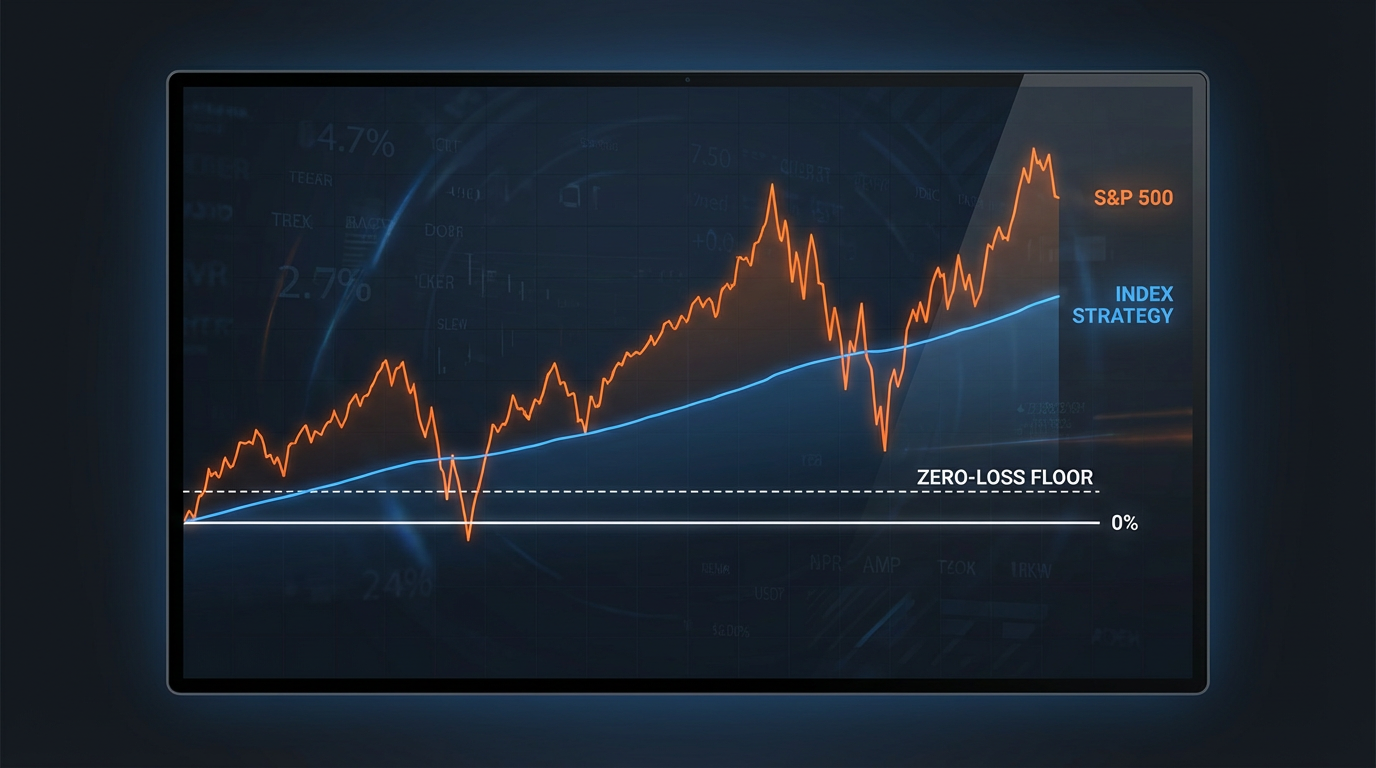
Historically, the S&P 500 has demonstrated strong long-term growth but with exposure to significant market downturns. For instance, a 30% market drop requires a subsequent 43% gain just to break even. This recovery math underscores the peril of volatility.
Index Strategies offer a compelling solution. By participating in market growth with a protective zero-loss floor, investors can experience steady compounding returns without the fear of losing principal during market slumps.
What are Index Strategies?
Index Strategies are financial vehicles that track the performance of well-known indices, like the S&P 500, without directly investing in them. They offer the potential for growth based on the index’s performance up to a predefined cap, while a zero-loss floor protects against market downturns.
The primary advantage of Index Strategies lies in their ability to anchor participants with a floor mechanism – ensuring the worst-case scenario reflects no loss of principal during negative market cycles. This protective feature becomes invaluable during periods of economic uncertainty.
Investors benefit from tax advantages as well, making these strategies robust tools for retirement planning. With proper implementation, they provide a diversified approach to financial security that withstands the test of volatile markets.
Why Consider Index Strategies Over Traditional Investments?
Traditional investment approaches often leave portfolios susceptible to fees, volatility, and taxes – the three silent killers of retirement savings. Index Strategies circumvent some of these pitfalls by providing a structured approach to capturing market gains without catastrophic losses.
For example, unlike traditional retirement accounts that may require distributions during market downturns, Index Strategies safeguard against forced sale losses by locking in gains annually. This feature ensures consistent growth even during market slumps.
By incorporating an indexed floor, Index Strategies also steer clear of the fee drag that plagues many managed accounts, enhancing long-term compounding effects for investors.
The Mechanics of Indexing: Floor and Cap Explained
Index Strategies utilize a ‘floor and cap’ mechanism, where the ‘floor’ represents the minimum return, ensuring no loss, and the ‘cap’ defines the maximum potential gain. This system offers a balance between growth potential and risk management.
If the S&P 500 gains 10% and your strategy caps gains at 8%, you secure that 8%, minus any downside risk due to market fluctuations. This protective mechanism is instrumental in sustaining growth across various market conditions.
Our experience demonstrates that securing a base year-after-year without losses allows for superior long-term growth through compounding – epitomized by the phrase, “Zero is Your Hero.”
How Tax Planning Fits Into Index Strategy Implementation
Effective tax planning is crucial for maximizing retirement strategy returns. With the three tax buckets framework, investors diversely manage tax exposure across taxable, tax-deferred, and tax-exempt accounts.
Index Strategies often align with tax-deferred or tax-exempt buckets, depending on the structure. This versatility helps investors optimize post-retirement incomes by reducing the tax drag associated with traditional accounts.
Understanding IRS regulations and required minimum distributions ensures that one not only benefits from compounding growth but does so in a tax-efficient manner.
Index Strategies vs. the S&P 500: A Strategic Comparison
Direct investment in the S&P 500 offers full market participation but at the expense of unmitigated loss exposure. In contrast, Index Strategies participate in market growth while stabilizing the base during downturns through a zero-loss floor.
S&P 500 vs Index Strategy: Protected Participation
The S&P 500 has historically delivered strong long-term returns – but with full exposure to market losses. Index Strategies track S&P 500 performance up to a cap rate, while a guaranteed floor ensures you never lose principal when the market drops. You participate in the growth. You are protected from the loss. If the S&P 500 drops 30%, a traditional investor loses 30% and needs a 43% gain just to break even. An Index Strategy investor loses 0% and captures the next market recovery from their full principal – compounding from a protected base. This is what we call Zero is Your Hero.
Planning for a Sustainable Retirement with Indexed Strategies
Building a sustainable retirement involves considering the reliability of income streams over sheer asset accumulation. Index Strategies align with this principle by ensuring growth and preservation, even in volatile markets.
These strategies act as a hedge against market unpredictability while still allowing participation in favorable economic conditions. By securing downside protection, they enable retirement planning free from the pitfalls of market loss.
The structured framework of an Index Strategy offers retirees a dependable source of income that supersedes traditional asset-focused planning – ensuring cash flow continuity over wealth paper valuations.