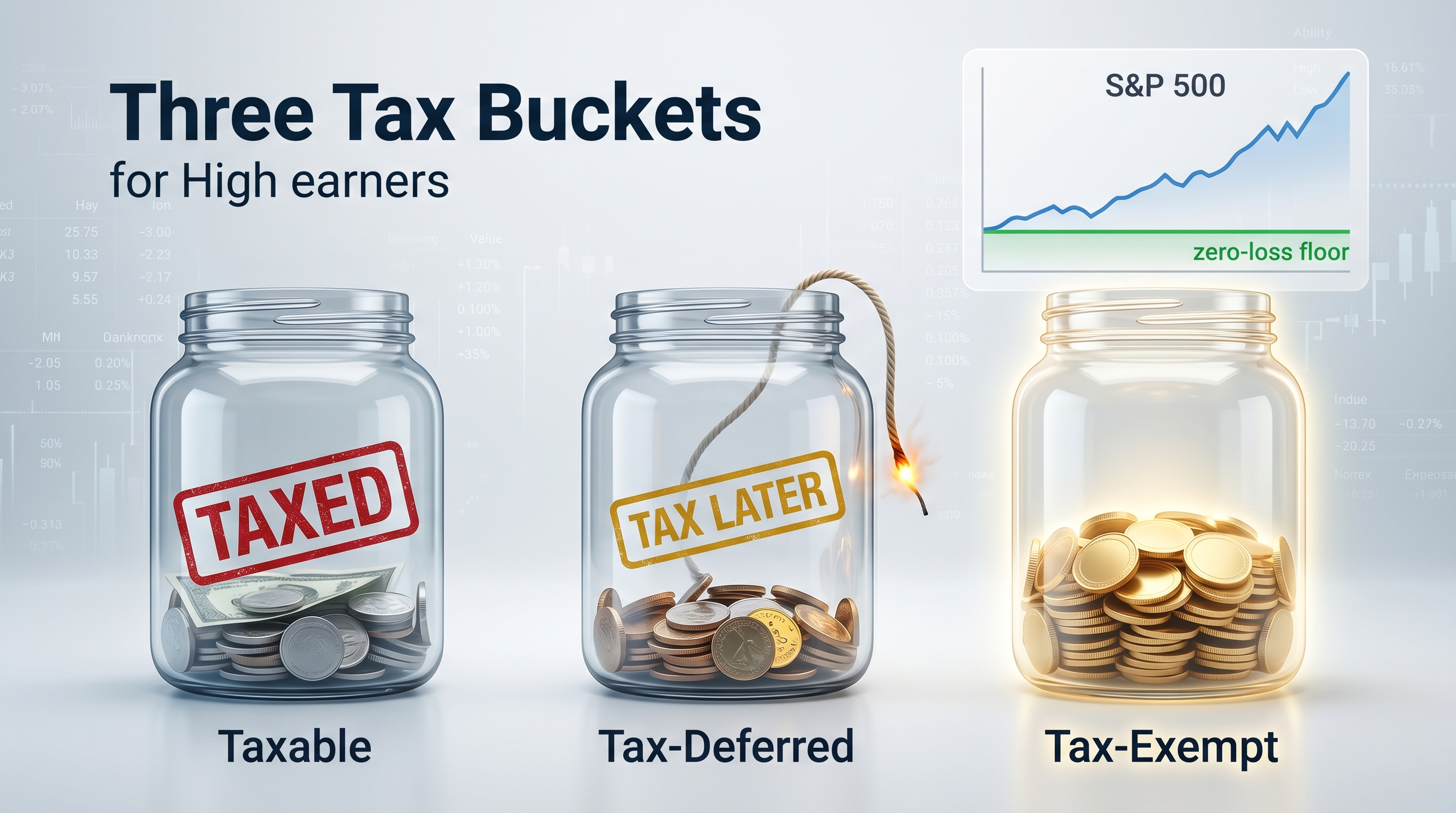
An Index Strategy offers tax-free retirement income by linking cash value growth to S&P 500 performance with zero-loss floor protection, allowing strategic tax-free withdrawals through policy loans. Unlike traditional retirement accounts facing Required Minimum Distributions and ordinary income tax rates, Everence Wealth structures Index Strategies to provide sustainable cash flow while preserving principal and legacy transfer—creating true tax diversification across the Three Tax Buckets framework.
Most retirement savers will face a brutal financial reality in their late 60s and early 70s: the tax bill they've been deferring for decades finally comes due—often at rates higher than when they originally contributed. We've worked with countless families who diligently maxed out 401k contributions for 30-plus years, only to discover that Required Minimum Distributions force them into higher tax brackets precisely when they need income flexibility most. The fundamental flaw in conventional retirement planning isn't the saving—it's the assumption that tax rates will be lower in retirement, an assumption that ignores the mathematical certainty of compounding tax liability and the political reality of escalating federal debt.
The retirement gap isn't just about having enough savings—it's about having the right kind of savings distributed across tax-efficient vehicles that won't penalize you for accessing your own money. Traditional tax-deferred accounts like 401ks and Traditional IRAs create a ticking tax time bomb: every dollar withdrawn triggers ordinary income taxation, potentially affecting Social Security taxation, Medicare premiums, and state tax obligations. For families in California, New York, New Jersey, and other high-tax states, combined federal and state marginal rates can exceed 45-50%, meaning nearly half of every retirement dollar withdrawn goes to government coffers rather than funding the retirement lifestyle you've worked decades to achieve.
This is where Index Strategies—specifically Indexed Universal Life insurance structured for cash value accumulation and strategic distribution—create a fundamentally different financial outcome. By linking cash value growth to S&P 500 performance with a zero-loss floor, then allowing tax-free access through policy loan provisions, Index Strategies provide what we call the Tax-Exempt Bucket: retirement income that doesn't trigger taxation, doesn't count toward provisional income calculations for Social Security, and doesn't force you into higher Medicare premium brackets. As independent brokers with access to 75+ carriers across all 50 states, we've stress-tested Index Strategies against traditional retirement vehicles for thousands of families—and the math consistently demonstrates superior after-tax retirement cash flow when properly structured and adequately funded.
How Does an Index Strategy Generate Tax-Free Retirement Income?
The mechanics of tax-free retirement income through an Index Strategy involve three interconnected components: premium funding that exceeds minimum death benefit requirements (creating accelerated cash value accumulation), crediting methods that participate in S&P 500 gains while protecting against market losses through annual reset mechanisms, and strategic distribution through policy loans that access cash value without creating taxable events. Unlike Roth IRAs with contribution limits ($7,000 annually for 2024, or $8,000 if age 50+), Index Strategies have no statutory contribution caps—allowing high-income professionals and business owners to fund substantially larger tax-exempt wealth accumulation vehicles.
Here's the critical distinction most financial advisors miss: policy loans are not distributions. When you take a loan against your Index Strategy cash value, you're borrowing from the insurance carrier using your policy as collateral—the loan proceeds are not considered income by the IRS, creating zero tax liability and zero reporting requirement. Your cash value continues earning index-linked returns on the full amount (minus any loan interest charges, which many carriers net against continued crediting), meaning your money compounds on both the amount you've accessed and the amount remaining in the policy. This is fundamentally different from 401k or IRA withdrawals, which permanently remove assets from tax-advantaged growth and trigger immediate taxation.
The S&P 500 vs Index Strategy framework applies directly to retirement income planning: traditional equity portfolios expose you to full market downside during your withdrawal years—the most dangerous financial period of your life. A 30% market correction when you're 68 years old doesn't just reduce your account balance; it forces you to sell more shares to generate the same income, permanently locking in losses and accelerating portfolio depletion. Index Strategies eliminate this sequence-of-returns risk entirely. If the S&P 500 drops 30%, your Index Strategy credits 0%—protecting your principal base and ensuring your next positive year compounds from your full account value, not a diminished balance requiring 43% gains just to break even. This is what we mean by Zero is Your Hero: your worst year is 0%, never negative, creating a protected foundation for sustainable lifetime income.
What Are the Three Tax Buckets and Why Does Tax Diversification Matter?
The Three Tax Buckets Framework organizes all financial assets into three categories based on tax treatment: Taxable (brokerage accounts, savings accounts, CDs, rental income—taxed annually on interest, dividends, and capital gains), Tax-Deferred (401ks, Traditional IRAs, 403bs, 457 plans—taxed at ordinary income rates upon withdrawal with Required Minimum Distributions starting at age 73), and Tax-Exempt (Roth IRAs, properly structured Index Strategies, Health Savings Accounts used for qualified medical expenses—no taxation on growth or qualified distributions). Most American families concentrate 70-90% of retirement assets in the Tax-Deferred bucket, creating catastrophic tax exposure and zero flexibility when managing retirement income.
Tax diversification provides strategic optionality that single-bucket strategies cannot deliver. Imagine you're 72 years old and need $80,000 for a new roof, unexpected medical expenses, or helping a grandchild with education costs. If all your money sits in Traditional IRAs, you must withdraw approximately $115,000-$145,000 (depending on your state) to net $80,000 after federal and state taxes—and that withdrawal might push you into a higher Medicare premium bracket (IRMAA surcharges) for the following two years, costing thousands more in additional healthcare expenses. If you have $80,000 available in your Index Strategy Tax-Exempt bucket, you access exactly $80,000 through a policy loan with zero tax consequence, zero impact on Social Security taxation, and zero Medicare premium implications.
The compounding advantage of tax-free distributions becomes exponential over a 25-30 year retirement horizon. Using the Rule of 72, money subject to 37% federal tax plus 9% state tax (46% combined marginal rate) effectively loses nearly half its growth potential compared to tax-exempt accumulation and distribution. Over three decades, this difference doesn't just impact your lifestyle—it determines whether your retirement assets last until age 95 or run out at age 82. We've modeled retirement income scenarios for families in high-tax states across thousands of cases: properly funded Index Strategies consistently deliver 30-60% more spendable lifetime income compared to equivalent contributions to tax-deferred accounts, purely due to elimination of taxation during the distribution phase.
How Do Index Strategies Compare to Roth IRAs for Tax-Free Income?
Roth IRAs and Index Strategies both provide tax-free retirement income, but operate under dramatically different rules regarding contributions, income limits, and distribution flexibility. Roth IRA contributions for 2024 are capped at $7,000 annually ($8,000 if age 50+) and phase out completely for married couples filing jointly with Modified Adjusted Gross Income above $240,000—effectively excluding high-income professionals, business owners, and dual-income households from direct Roth contributions. Index Strategies have no income restrictions and no statutory contribution limits, allowing families to fund $25,000, $50,000, or $100,000+ annually depending on policy design and Modified Endowment Contract (MEC) testing limits.
The five-year aging requirement and Roth conversion tax treatment create additional complexity. Roth IRA earnings cannot be accessed tax-free until age 59½ and the account has been open for at least five years—limiting flexibility for early retirement or bridge income strategies. Roth conversions (moving Traditional IRA money into Roth status) trigger immediate taxation on the converted amount at ordinary income rates, often creating six-figure tax bills for families with substantial IRA balances. Index Strategies allow tax-free access to cash value through policy loans at any age with no waiting period—providing substantially more liquidity and flexibility for families pursuing financial independence before traditional retirement age.
Estate planning considerations further differentiate these vehicles. Roth IRAs pass to beneficiaries tax-free but are subject to the SECURE Act's 10-year distribution requirement for most non-spouse beneficiaries, potentially forcing distributions during the beneficiary's peak earning years when tax rates are highest. Index Strategies provide income-tax-free death benefits to beneficiaries with no required distribution schedule—allowing legacy assets to pass completely outside the income tax system while providing immediate liquidity for estate settlement, business succession, or generational wealth transfer. For families with estates approaching or exceeding federal estate tax exemption levels ($13.61 million individual, $27.22 million married for 2024), Index Strategies can be owned by Irrevocable Life Insurance Trusts (ILITs) to remove death benefits from the taxable estate entirely.
S&P 500 vs Index Strategy: Protected Participation in Retirement
The S&P 500 has historically delivered strong long-term returns—but with full exposure to market losses that can devastate retirement income plans. Index Strategies track S&P 500 performance up to a cap rate (typically 9-12% annually depending on carrier and crediting method), while a guaranteed floor ensures you never lose principal when the market drops. You participate in the growth. You are protected from the loss.
If the S&P 500 drops 30%, a traditional investor loses 30% and needs a 43% gain just to break even—often taking years and forcing increased withdrawals to maintain income, accelerating portfolio depletion. An Index Strategy investor loses 0% and captures the next market recovery from their full principal—compounding from a protected base without sequence-of-returns risk. This is what we call Zero is Your Hero: protected compounding creates sustainable income that won't be derailed by market timing or correction cycles during your distribution years.
The annual reset mechanism locks in gains each policy anniversary. If you're credited 11% in year one, that gain becomes your new protected base—future market declines cannot erase previously credited returns. This ratcheting effect compounds safety and growth simultaneously, creating retirement income strategies that deliver market-linked upside without the portfolio depletion risk that destroys conventionally managed retirement accounts during prolonged bear markets or high-volatility periods.
What Role Do Index Strategies Play in Retirement Income Planning?
Index Strategies function as the Tax-Exempt Bucket foundation in comprehensive retirement income architecture, complementing rather than replacing qualified retirement accounts and Social Security. The optimal retirement income strategy creates intentional withdrawal sequencing: during early retirement years (age 60-72), access Index Strategy policy loans to fund lifestyle while delaying Social Security (increasing lifetime benefits by 6-8% annually through age 70) and allowing tax-deferred accounts to continue compounding. Once Social Security begins and Required Minimum Distributions commence at age 73, use Index Strategy distributions to supplement income without increasing taxable income that would trigger higher tax brackets or Medicare premium surcharges.
This sequencing strategy provides control over provisional income—the formula used to determine Social Security taxation. Up to 85% of Social Security benefits become taxable when provisional income (Adjusted Gross Income + tax-exempt interest + 50% of Social Security benefits) exceeds $44,000 for married couples filing jointly. By using Index Strategy policy loans for supplemental income rather than IRA withdrawals, you can potentially keep provisional income below taxation thresholds, preserving more Social Security benefits tax-free. For a couple receiving $50,000 annually in Social Security, this strategy can save $4,000-$7,000 per year in federal taxes alone—money that remains available for spending, gifting, or additional wealth accumulation.
The Cash Flow > Net Worth principle becomes critical during retirement distribution years. A $2 million portfolio that generates $80,000 annual income after taxes and fees provides fundamentally different financial security than a $1.2 million Index Strategy providing $80,000 annual tax-free income through policy loans. The smaller asset base delivering equivalent spendable income with zero tax exposure and zero market risk often provides superior lifestyle sustainability and legacy outcomes. We've worked with families who delayed Index Strategy funding for years, chasing higher net worth numbers in market-exposed accounts, only to realize during retirement that after-tax, risk-adjusted cash flow—not gross asset value—determines quality of life.
How Should High-Income Professionals Structure Index Strategies for Maximum Tax-Free Income?
High-income professionals—physicians, attorneys, executives, business owners, software engineers—face contribution limits and income restrictions that exclude them from maximum Roth IRA funding while exposing them to highest marginal tax brackets during peak earning years. For these families, Index Strategies structured as maximum overfunded policies (contributions significantly exceeding minimum death benefit costs) create the largest possible Tax-Exempt Bucket without triggering Modified Endowment Contract status that would eliminate tax-free loan treatment. Proper MEC testing requires precise policy design: death benefit must remain sufficiently high relative to cash value to maintain life insurance classification under IRC Section 7702, while premium funding maximizes cash accumulation.
We typically recommend minimum 10-15 year premium commitment for professionals age 35-50 seeking to build substantial tax-free retirement income by age 60-65. A 40-year-old professional funding $50,000 annually into a properly structured Index Strategy with consistent 7-8% average crediting (net of costs) can accumulate $1.2-$1.5 million in cash value by age 60, supporting $70,000-$90,000 in annual tax-free policy loans from age 60 through life expectancy while preserving death benefit for legacy transfer. This same professional maxing out 401k contributions ($23,000 for 2024, plus $7,500 catch-up if age 50+) would need distributions of $100,000-$130,000 from tax-deferred accounts to net equivalent after-tax spending—requiring substantially larger accumulation and exposing the entire portfolio to sequence-of-returns risk during market downturns.
Carrier selection and crediting method optimization require independent broker expertise. The difference between a well-structured Index Strategy and a poorly designed policy can mean 2-3% annual performance variance over 25-30 years—translating to hundreds of thousands in reduced cash value and income capacity. As independent brokers with 75+ carrier relationships, we stress-test policy illustrations across multiple scenarios: historical S&P 500 backtesting, prolonged low-return environments, high-volatility sequences, and varying policy loan utilization patterns. This multi-carrier comparison ensures you're not locked into a single insurance company's crediting methodology, fee structure, or financial strength rating—you receive the optimal strategy for your specific age, health classification, income level, and retirement timeline.
What Are the Tax Implications of Policy Loans vs Traditional Retirement Withdrawals?
Policy loans from Index Strategies create zero taxable income because they're classified as debt, not distributions—you're borrowing against your cash value using the policy as collateral. The IRS does not require reporting of policy loans on tax returns (unless the policy lapses with outstanding loans exceeding basis, creating potential taxable gain), and loans do not appear on Form 1099-R or any other income reporting document. This creates complete tax invisibility: no impact on Adjusted Gross Income, no impact on provisional income for Social Security taxation, no impact on Medicare premium calculations (IRMAA), and no impact on state income taxes.
Traditional retirement account withdrawals, by contrast, generate Form 1099-R reporting and are included in Adjusted Gross Income as ordinary income subject to marginal federal rates (currently 10%, 12%, 22%, 24%, 32%, 35%, or 37% depending on taxable income level) plus state income taxes ranging from 0% in states like Texas and Florida to 13.3% in California's highest bracket. A $60,000 IRA withdrawal for a married couple in the 24% federal bracket living in New York (6.85% state rate) generates $18,510 in combined income taxes—leaving only $41,490 in spendable proceeds. A $60,000 Index Strategy policy loan delivers the full $60,000 with zero tax consequence, a 45% improvement in after-tax purchasing power from identical gross distribution amounts.
Required Minimum Distributions compound this taxation burden by forcing withdrawals whether you need the money or not. Starting at age 73 (for individuals born 1951-1959) or age 75 (for those born 1960 or later), RMDs calculate mandatory annual withdrawals based on IRS life expectancy tables—typically starting around 3.8% of account balance and increasing each year. For retirees with substantial IRA balances ($1 million+), RMDs can easily push annual income into six figures even if Social Security and other income sources already provide sufficient cash flow—triggering higher tax brackets, Medicare surcharges, and taxation of Social Security benefits purely due to forced distributions. Index Strategies have no Required Minimum Distributions, allowing complete control over distribution timing, amount, and tax consequence throughout your lifetime.
About Steven Rosenberg & Everence Wealth
Steven Rosenberg serves as Founder and Chief Wealth Strategist at Everence Wealth, a San Francisco-based independent insurance brokerage specializing in tax-efficient Index Strategies and retirement income planning for families across all 50 states. As an independent broker with 75+ carrier partnerships, Steven works exclusively in the client's best interest—not for any insurance company, bank, or Wall Street institution. His expertise centers on Index Strategies utilizing S&P 500-linked growth with zero-floor protection, the Three Tax Buckets framework for retirement tax diversification, and Cash Flow > Net Worth retirement income architecture. Steven has structured Index Strategies for physicians, attorneys, business owners, tech professionals, and multi-generational families seeking to eliminate retirement tax exposure while preserving market participation and legacy transfer capability. His educational approach emphasizes mathematical transparency—using historical S&P 500 data, IRS tax code analysis, and carrier-specific crediting method backtesting to demonstrate how properly structured Index Strategies deliver superior after-tax retirement outcomes compared to conventional tax-deferred accumulation. Everence Wealth maintains no proprietary investment products, no asset-based fees on insurance strategies, and no institutional conflicts of interest—providing truly independent analysis and carrier selection based solely on client-specific optimization rather than commission maximization or corporate sales quotas.
Build Your Tax-Free Retirement Income Strategy
If you're concerned about retirement tax exposure, Required Minimum Distribution penalties, or market volatility during your distribution years, a Financial Needs Assessment will stress-test your current strategy against the Three Silent Killers: fees, volatility, and taxes. We'll analyze your existing 401k, IRA, and brokerage account balances, project RMD schedules and tax consequences, then model Index Strategy funding scenarios designed to maximize tax-free retirement income while preserving principal protection and legacy transfer. This comprehensive analysis compares after-tax cash flow across multiple retirement income architectures, allowing you to make informed decisions about Tax Bucket diversification before it's too late to implement meaningful change. Schedule your Financial Needs Assessment to discover whether Index Strategies can reduce your lifetime tax burden and increase sustainable retirement spending.
Schedule Your Financial Needs AssessmentThis content is for educational purposes only and does not constitute financial, tax, or legal advice. Index Strategy performance depends on carrier crediting methods, policy structure, premium funding levels, and S&P 500 performance. Policy loans reduce death benefit and available cash value; loans exceeding basis in a lapsed policy may create taxable income. Tax-free treatment assumes policy remains in force and does not become a Modified Endowment Contract. Required Minimum Distribution rules, tax brackets, and Medicare premium thresholds are subject to change by Congress. Consult a licensed insurance professional, tax advisor, and attorney before implementing any Index Strategy or retirement income plan.