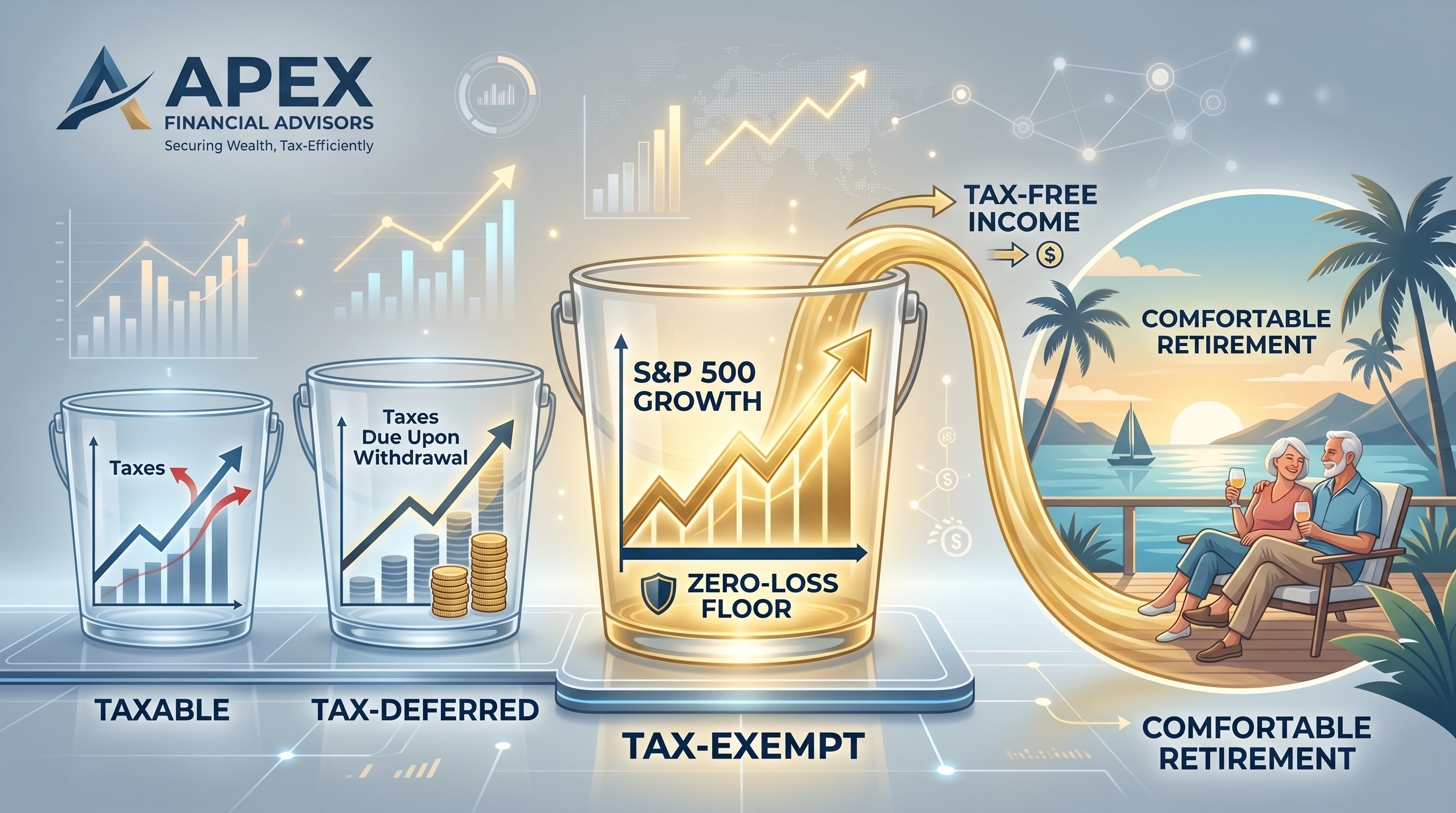
Indexed Universal Life insurance offers tax-free retirement income through policy loans, downside protection with a zero-loss floor, and upside participation in S&P 500 growth. At Everence Wealth, we structure Index Strategies using the Three Tax Buckets framework, positioning IUL in the tax-exempt bucket to complement taxable and tax-deferred accounts for diversified retirement income flexibility.
Most Americans approaching retirement face a silent crisis: their retirement accounts sit entirely in tax-deferred buckets, exposed to Required Minimum Distributions, market volatility without protection, and the compounding erosion of fees over decades. After working with hundreds of families across all fifty states, we've seen portfolios that look substantial on paper collapse under the weight of taxes, market corrections, and withdrawal strategies that weren't stress-tested for longevity. The retirement gap—the difference between what you've saved and what you'll actually need—grows wider each year as traditional strategies fail to account for the Three Silent Killers: fees, volatility, and taxes.
Indexed Universal Life insurance (IUL) represents a fundamentally different approach to retirement wealth accumulation. Unlike qualified retirement plans that defer taxes until withdrawal, IUL builds cash value in the tax-exempt bucket, offering policy loans that generate retirement income without triggering taxable events, Required Minimum Distributions, or IRMAA surcharges on Medicare premiums. The strategy combines life insurance protection with an accumulation vehicle that tracks S&P 500 performance through indexing, capturing market gains up to a cap rate while maintaining a guaranteed floor that protects principal from market losses. This is what we call Zero is Your Hero—your worst year is zero percent, not negative thirty percent.
As an independent broker partnered with seventy-five-plus carriers, we stress-test Index Strategies against traditional retirement vehicles to identify which families benefit most from tax-exempt accumulation, protection-based growth, and estate planning advantages. We don't work for insurance companies, banks, or Wall Street institutions—we work exclusively in the client's best interest, accessing wholesale-priced strategies unavailable through retail financial channels. This article explains exactly how Indexed Universal Life insurance functions as a retirement planning tool, who should consider it, and how it integrates with your existing tax bucket strategy to build sustainable, tax-efficient cash flow for life.
What Makes Indexed Universal Life Different From Traditional Retirement Accounts?
Indexed Universal Life insurance occupies the tax-exempt bucket in retirement planning, fundamentally distinguishing it from 401(k)s, Traditional IRAs, and even Roth IRAs in structure, taxation, and access. While qualified retirement plans accumulate wealth through tax deferral—postponing taxes until Required Minimum Distributions force withdrawals—IUL builds cash value inside a life insurance contract, allowing policy loans that are not classified as taxable income. This structural difference creates retirement income that doesn't increase your adjusted gross income, trigger IRMAA Medicare surcharges, or subject your Social Security benefits to taxation. For high-income professionals and business owners in states like California, New York, and New Jersey where combined federal and state tax rates exceed forty-five percent, this tax treatment transforms retirement cash flow planning.
The second defining characteristic is downside protection through the zero-loss floor. Traditional retirement accounts invested in the S&P 500 experience full market exposure—when the index drops thirty percent, the account drops thirty percent, requiring a forty-three percent gain just to break even due to the mathematics of loss recovery. Indexed Universal Life contracts credit interest based on S&P 500 performance up to a cap rate (typically ten to thirteen percent annually depending on carrier and contract), but guarantee zero percent as the floor in negative years. Your cash value never decreases due to market performance. Instead, gains lock in annually through the Annual Reset mechanism, protecting each year's growth from future downturns and allowing compounding from a continually protected base. This is the core advantage of S&P 500 vs Index Strategy positioning: you participate in growth while being protected from loss.
The third distinction involves liquidity and control. While 401(k) withdrawals before age fifty-nine-and-a-half trigger ten percent early withdrawal penalties plus ordinary income tax, IUL policy loans can be accessed at any age without penalties, taxes, or Required Minimum Distribution mandates. This creates strategic flexibility for early retirees, business owners managing irregular income, and families bridging the gap between retirement and Social Security or pension activation. Additionally, IUL death benefits pass income-tax-free to beneficiaries outside of probate, providing estate planning advantages that qualified retirement accounts cannot match. We've structured strategies for families where the death benefit alone replaces the need for term life insurance, effectively making the retirement accumulation strategy cost-neutral when accounting for protection value.
How Does the S&P 500 Indexing Mechanism Work Inside an IUL Policy?
Indexed Universal Life policies do not directly invest in the stock market. Instead, insurance carriers use your premium payments to purchase bonds and fixed-income securities, then allocate a portion of the bond yield to purchase S&P 500 index options. When the S&P 500 increases during the contract year, the option gains are credited to your cash value up to the policy's cap rate. When the S&P 500 declines, the options expire worthless, but your principal remains protected by the insurance company's general account assets backing the policy guarantees. This structure is why IUL is often described as participating in market upside without market downside—you're not invested in equities, but your returns are linked to equity index performance.
The cap rate and participation rate are the two variables that determine how much S&P 500 growth credits to your policy. A cap rate of twelve percent means that if the S&P 500 gains twenty percent in a contract year, your policy credits twelve percent. A participation rate of one hundred percent with a cap means you receive dollar-for-dollar index gains up to the cap; participation rates below one hundred percent (such as seventy percent) mean you receive seventy cents of every dollar of index gain up to the cap. Current market conditions—specifically interest rates and option pricing—directly influence these rates. Higher interest rate environments generally produce higher cap rates because carriers earn more on their bond portfolios, allowing greater option purchases. This is why we've seen cap rates improve significantly in recent years after a prolonged low-rate period.
The Annual Reset feature locks in gains each contract anniversary, resetting your protected base to the new higher cash value. If your policy credits ten percent in year one, that ten percent becomes part of your protected principal going forward—it cannot be lost in subsequent market downturns. This creates a ratcheting effect where each positive year permanently increases your floor, eliminating sequence-of-returns risk that devastates traditional portfolios during market corrections near retirement. Compare this to a retiree with a million-dollar 401(k) who experiences a thirty percent market loss in year one of retirement: that account drops to seven hundred thousand dollars and must gain forty-three percent just to recover, all while the retiree continues taking withdrawals that accelerate depletion. An IUL-based strategy never experiences that drawdown, maintaining full principal access throughout market cycles.
Who Benefits Most From Using IUL as a Retirement Strategy?
Indexed Universal Life insurance serves specific financial profiles more effectively than others. The ideal candidates are individuals who have maximized tax-deferred contributions, face high current or future tax exposure, seek downside protection with growth potential, and value estate planning integration. High-income professionals—physicians, attorneys, executives, engineers, and business owners—earning above the Roth IRA income limits often discover IUL as the only remaining tax-advantaged accumulation vehicle available after maxing out workplace retirement plans. Unlike Roth IRAs which phase out at modified adjusted gross incomes of two hundred forty thousand dollars for married couples, IUL has no income limits, no contribution caps beyond premium funding guidelines, and no Required Minimum Distributions forcing liquidation in your seventies and eighties.
Business owners with irregular income particularly benefit from IUL's flexibility. Unlike qualified retirement plans requiring consistent contributions and nondiscrimination testing, IUL premiums can be adjusted year to year based on cash flow, allowing larger contributions in profitable years and reduced funding during lean periods without penalty. We've structured strategies for entrepreneurs who fund aggressively during liquidity events—selling a business, exercising stock options, receiving bonuses—then reduce or pause premiums during reinvestment phases, all while maintaining policy coverage and accumulated cash value. This flexibility is impossible with defined benefit plans or SEP IRAs that mandate contribution formulas.
Families concerned about estate taxes and wealth transfer also find IUL advantageous. The death benefit passes income-tax-free to beneficiaries, effectively multiplying the legacy value of contributed premiums. A fifty-year-old funding an IUL strategy with thirty thousand dollars annually for twenty years may accumulate eight hundred thousand in cash value by age seventy while maintaining a two-million-dollar death benefit. That two-million-dollar transfer occurs outside probate, avoids income taxation, and can be structured with irrevocable life insurance trusts (ILITs) to remove it from estate tax calculations. For families exceeding the current estate tax exemption thresholds, this creates significant multigenerational wealth preservation compared to leaving taxable retirement accounts that trigger income tax to heirs and potentially estate tax to the estate.
How Does IUL Fit Into the Three Tax Buckets Framework?
The Three Tax Buckets Framework
- Taxable: This bucket includes checking accounts, savings accounts, brokerage accounts, and any investments held outside retirement wrappers. Every dividend, interest payment, and capital gain triggers annual taxation, creating drag on compounding. These accounts offer maximum flexibility and liquidity but minimum tax efficiency. For retirees, taxable accounts provide accessible emergency funds and short-term cash flow, but their ongoing tax burden makes them poor long-term wealth accumulators. We typically recommend keeping six to twelve months of expenses in taxable accounts for liquidity, then strategically positioning growth assets in more tax-efficient buckets.
- Tax-Deferred: Traditional 401(k)s, 403(b)s, Traditional IRAs, SEP IRAs, and SIMPLE IRAs comprise this bucket. Contributions reduce current taxable income, investments grow without annual taxation, but every withdrawal is taxed as ordinary income at your future tax rate. The critical flaw is Required Minimum Distributions beginning at age seventy-three under current law, forcing withdrawals whether you need the income or not, potentially pushing you into higher tax brackets, triggering IRMAA surcharges, and causing up to eighty-five percent of Social Security benefits to become taxable. Tax-deferred accounts are excellent accumulation vehicles during working years but become tax time bombs in retirement when withdrawals coincide with pension income, Social Security, and investment income, creating what we call the Retirement Tax Torpedo.
- Tax-Exempt: Roth IRAs, Roth 401(k)s, Health Savings Accounts (when used for medical expenses), and Indexed Universal Life policy loans occupy this bucket. Growth and distributions occur tax-free, providing maximum control over retirement tax planning. Unlike Roth accounts which have contribution limits and income restrictions, IUL has no contribution caps beyond insurability limits and premium funding guidelines. Policy loans—the mechanism for accessing IUL cash value—are not classified as income, never trigger Required Minimum Distributions, and don't increase adjusted gross income for IRMAA or Social Security taxation calculations. For families anticipating higher future tax rates or significant tax-deferred balances creating RMD problems, building substantial tax-exempt bucket capacity through IUL creates the flexibility to control which bucket you draw from each year, optimizing tax liability annually throughout a thirty-plus-year retirement.
Strategic tax bucket diversification means having accessible assets in all three buckets, allowing you to choose each year which account to draw from based on tax rates, income needs, and legislative changes. A retiree with five hundred thousand in taxable accounts, two million in tax-deferred IRAs, and one million in IUL-based tax-exempt assets can strategically draw from the taxable bucket during low-income years to fill lower tax brackets, tap tax-exempt IUL for larger expenses that would otherwise push them into higher brackets, and delay tax-deferred withdrawals until Required Minimum Distributions mandate them. This flexibility can save hundreds of thousands in lifetime taxes compared to relying solely on tax-deferred accounts where every dollar of retirement income is taxed at ordinary rates.
What Are the Costs and How Do They Compare to Traditional Investments?
Indexed Universal Life policies carry internal costs that differ structurally from mutual fund expense ratios or advisory fees in brokerage accounts. The primary costs include cost of insurance (the mortality charge for the death benefit), administrative fees, premium load charges, and surrender charges during early policy years. Transparency around these costs is critical because they directly impact cash value accumulation, particularly in the first decade of the policy. Cost of insurance increases annually as you age, reflecting the rising actuarial cost of providing the death benefit. This is why IUL is most cost-efficient when started younger—a forty-year-old's mortality costs are substantially lower than a sixty-year-old's, allowing more of each premium dollar to reach cash accumulation.
However, comparing IUL costs to investment account fees requires understanding what you're purchasing. A one percent mutual fund expense ratio in a 401(k) compounds against your balance for thirty-five years—using the Rule of 72, we can estimate this seemingly small fee cuts your ending balance by approximately twenty-five to thirty percent over a full career compared to a zero-fee alternative. That's the power of compounding working in reverse. IUL costs are front-loaded, meaning surrender charges and higher early-year expenses decline over time, eventually resulting in minimal ongoing costs once the policy matures. Additionally, IUL costs include life insurance protection—a benefit that has tangible value. For a fifty-year-old funding retirement, comparing the IUL's cost structure to a combination of term life insurance plus a taxable brokerage account often reveals the IUL is cost-competitive or superior once you account for the death benefit value, tax-free growth, and downside protection.
We stress-test every IUL illustration against alternative strategies using conservative assumptions: cap rates of eight to nine percent rather than illustrated rates of ten to twelve percent, policy loans beginning at planned retirement age, and fees continuing throughout the contract period. This conservative modeling ensures families understand realistic outcomes rather than best-case scenarios. For policies properly funded—meaning premium levels that efficiently cover costs while maximizing cash accumulation—the net cost after accounting for death benefit value and tax savings typically compares favorably to retail investment products with advisory fees, fund expenses, and tax drag. The key is working with an independent broker who has access to seventy-five-plus carriers, allowing selection of the most cost-efficient contracts rather than being limited to a single company's product lineup.
How Do You Structure IUL Policy Loans for Tax-Free Retirement Income?
Policy loans are the mechanism that converts IUL cash value into tax-free retirement income. Unlike withdrawals that remove cash value from the policy and may trigger taxable gain recognition if you exceed your cost basis, policy loans borrow against your cash value while leaving the full amount inside the contract to continue crediting interest. The insurance carrier charges loan interest—typically four to five percent—but your cash value continues earning indexed credits on the full balance, creating potential arbitrage when index credits exceed loan costs. This structure is why properly designed IUL strategies can provide sustainable retirement income without depleting the policy or triggering taxation.
The best practice is structuring policy loans during retirement planning, not as an afterthought. We typically recommend building cash value for fifteen to twenty years before initiating loans, allowing substantial accumulation that can support three to four percent annual distribution rates throughout retirement. For example, a forty-five-year-old funding thirty thousand dollars annually into a well-structured IUL policy may accumulate one million dollars in cash value by age sixty-five. Beginning policy loans of forty thousand dollars annually at that point provides sustainable income while the death benefit remains intact for estate planning. If index credits average seven to eight percent and loan costs run four to five percent, the net growth continues supporting distributions for decades without policy lapse risk.
Critical to this strategy is understanding participating loan features offered by some carriers. Traditional fixed loans charge a set rate and credit a lower fixed rate to loaned cash value, creating negative arbitrage. Participating loans or indexed loans credit the full indexed return to loaned values, eliminating the spread and dramatically improving sustainability. This feature alone can add hundreds of thousands of dollars in accessible retirement income over a thirty-year distribution period. Not all carriers offer this feature, which is why working with an independent broker who can compare policy features across seventy-five-plus carriers is essential. Retail advisors captive to one insurance company simply cannot offer this level of optimization because they're limited to their company's product lineup, which may or may not include the most competitive loan provisions.
What Are the Risks and How Do You Mitigate Them?
Indexed Universal Life policies carry risks that must be understood and actively managed. The primary risk is policy lapse—the policy terminating due to insufficient cash value to cover internal costs, typically caused by underfunding, excessive loans, or prolonged periods of zero index credits preventing cash value growth. A lapsed policy after taking substantial loans can trigger a taxable event where all loaned amounts exceeding your cost basis become taxable income in a single year, creating devastating tax consequences. Preventing lapse requires conservative funding, monitoring cash value performance, and adjusting loan amounts if index performance underperforms expectations over extended periods.
The second risk involves illustrated versus actual performance. Insurance illustrations often show cap rates of eleven to twelve percent and assume those rates remain constant for decades. In reality, cap rates fluctuate based on interest rate environments and carrier profitability. A policy illustrated at twelve percent caps that actually experiences eight percent average caps will accumulate substantially less cash value than projected. This is why we stress-test every policy at multiple cap rate assumptions—typically running scenarios at nine percent, seven percent, and even six percent average caps to ensure the strategy remains viable under adverse conditions. Families should review policy performance annually and adjust funding or distribution plans if actual credits fall below projections.
The third risk is carrier financial strength. Your IUL policy is only as secure as the insurance company backing it. Unlike FDIC-insured bank accounts or SIPC-protected brokerage accounts, life insurance cash values are backed by the carrier's general account assets and claims-paying ability. This is why we exclusively recommend carriers rated A+ or higher by A.M. Best, AA or higher by S&P, and with decades of financial stability and surplus ratios well above regulatory minimums. Diversifying across multiple carriers for clients funding several policies also mitigates concentration risk. As an independent broker with seventy-five-plus carrier relationships, we're not incentivized to place business with any single company—we select based purely on financial strength, product features, and cost competitiveness for each client's specific situation.
About Steven Rosenberg & Everence Wealth
Steven Rosenberg is the Founder and Chief Wealth Strategist at Everence Wealth, a San Francisco-based independent insurance brokerage specializing in tax-efficient Index Strategies, retirement income planning, and asset protection for families across all fifty states. As an independent broker partnered with seventy-five-plus insurance carriers, Steven works exclusively in the client's best interest—not for any insurance company, bank, or Wall Street institution. His practice focuses on bridging the retirement gap through strategic positioning across the Three Tax Buckets framework, incorporating Indexed Universal Life insurance, annuities, and protection-based wealth strategies that prioritize downside protection, tax efficiency, and sustainable cash flow over net worth accumulation. Steven's expertise includes S&P 500 indexed strategy mechanics, zero-floor protection modeling, Required Minimum Distribution planning, IRMAA surcharge mitigation, and estate planning integration for high-income professionals, business owners, and families concerned about volatility, taxation, and legacy wealth transfer. His educational approach centers on exposing the Three Silent Killers—fees, volatility, and taxes—that erode traditional retirement accounts, while teaching concepts like Zero is Your Hero, Cash Flow Over Net Worth, and Retail versus Wholesale financial system positioning. Every strategy is stress-tested using conservative assumptions to ensure viability across multiple economic scenarios, providing families with confidence that their retirement plan can withstand market corrections, tax law changes, and longevity beyond initial projections. Everence Wealth serves clients nationwide from its San Francisco headquarters, offering comprehensive Financial Needs Assessments that analyze current tax bucket exposure, identify retirement income gaps, and design customized Index Strategy solutions tailored to each family's specific risk tolerance, income needs, and legacy goals.
Stress-Test Your Retirement Strategy With a Financial Needs Assessment
If you're approaching retirement with substantial balances in tax-deferred accounts, facing Required Minimum Distribution exposure, or concerned about market volatility eroding your nest egg during distribution years, it's time to evaluate whether your current strategy truly supports thirty-plus years of tax-efficient income. Our Financial Needs Assessment analyzes your existing tax bucket positioning, projects lifetime tax liability under current and potential future rates, models sequence-of-returns risk against your planned retirement date, and identifies whether Index Strategies can improve your retirement income sustainability while reducing exposure to the Three Silent Killers. As an independent broker with access to seventy-five-plus carriers, we're not limited to any single company's products—we design solutions based exclusively on your best interest, comparing features, costs, and performance across the entire marketplace. Schedule your Financial Needs Assessment today to discover whether Indexed Universal Life insurance and tax-exempt bucket strategies can strengthen your retirement plan, protect your legacy, and provide the confidence that your wealth will last as long as you do.
Schedule Your Financial Needs AssessmentThis content is for educational purposes only and does not constitute financial, tax, or legal advice. Indexed Universal Life insurance policies contain fees, charges, and limitations. Policy performance depends on the financial strength of the issuing carrier, actual credited interest rates, and proper funding levels. Consult a licensed insurance professional and tax advisor before making any financial decisions regarding retirement planning or life insurance strategies.