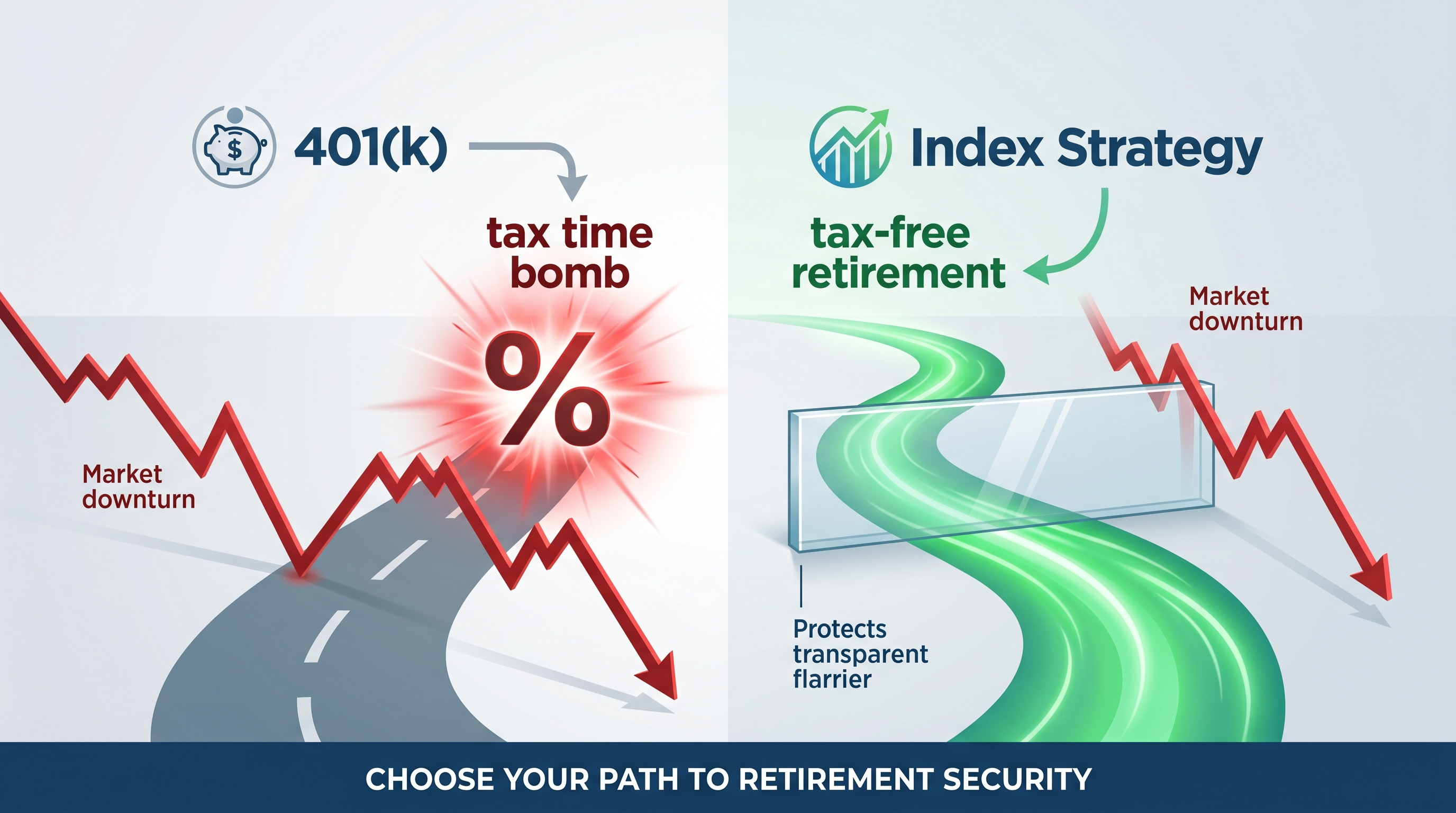
Index Strategies provide tax-free retirement income by tracking S&P 500 performance with a guaranteed zero-loss floor, allowing growth without market downside exposure. At Everence Wealth, we guide families through S&P 500 vs Index Strategy comparisons, showing how Zero is Your Hero protects principal while capturing gains. Unlike tax-deferred accounts, properly structured Index Strategies offer tax-exempt distributions, no required minimum distributions, and protected compounding from a stable base.
Most Americans believe their 401(k) or traditional IRA represents their path to financial freedom in retirement. Yet when distributions begin, many retirees discover an uncomfortable truth: every dollar withdrawn triggers ordinary income tax at rates potentially higher than during their working years. Meanwhile, Required Minimum Distributions force taxable withdrawals whether you need the income or not, and market volatility can devastate account balances precisely when recovery time has disappeared. This creates what we call the Retirement Tax Time Bomb—a hidden liability that can consume 30% to 40% of your life savings.
The challenge facing today's pre-retirees is navigating three simultaneous threats: rising tax brackets as federal debt grows, S&P 500 volatility without time to recover from losses, and the relentless compound drag of management fees over 30-35 years. Traditional financial planning often focuses exclusively on accumulation—maximizing account balances on paper—while ignoring the tax treatment, liquidity restrictions, and downside exposure that determine actual retirement income. We've seen too many families reach retirement with substantial net worth but insufficient tax-efficient cash flow to sustain their lifestyle without triggering massive tax bills.
At Everence Wealth, we guide families through a different approach: Index Strategies that track S&P 500 performance with a guaranteed zero-loss floor, annual reset protection, and tax-free distribution potential. These strategies bridge the gap between aggressive market growth and conservative capital preservation, allowing you to participate in S&P 500 gains while your worst year remains 0%—not negative. This article explains exactly how Index Strategies generate tax-free retirement income, the mechanics behind the zero floor, and why diversifying across all Three Tax Buckets creates sustainable lifetime cash flow regardless of future tax policy changes.
What Makes Index Strategy Retirement Income Tax-Free?
The tax-free income potential of Index Strategies comes from their unique structure as permanent life insurance contracts governed by Section 7702 of the Internal Revenue Code. Unlike qualified retirement accounts where every dollar withdrawn counts as ordinary income, properly structured Index Strategies allow you to access accumulated cash value through tax-free policy loans and withdrawals up to basis. The death benefit component, when properly funded, creates a tax-advantaged wrapper around S&P 500-linked growth, enabling tax-free distributions during retirement and a tax-free death benefit to beneficiaries. This positions your Index Strategy in the Tax-Exempt bucket—alongside Roth IRAs but without contribution limits, income phase-outs, or required minimum distributions.
The mechanics work through overfunding the policy beyond minimum death benefit requirements, allowing substantial cash accumulation that grows based on S&P 500 index performance within contractually guaranteed parameters. When you need retirement income, you take policy loans against the cash value rather than surrendering the policy. These loans are not considered taxable distributions because you're borrowing against your own asset rather than liquidating it. The loan balance is ultimately settled through the death benefit, which passes income-tax-free to your beneficiaries. This creates a tax-free income stream that continues for life without triggering Social Security taxation, Medicare premium increases, or capital gains recognition.
We structure Index Strategies to maximize cash accumulation while maintaining IRS compliance through careful premium planning and death benefit corridor management. The goal is building the largest possible tax-free retirement income while preserving the life insurance classification that makes tax-free treatment possible. This requires working with carriers who understand advanced Index Strategy design and independent brokers—like our team at Everence Wealth—who architect policies specifically for retirement income rather than maximum death benefit. When properly executed, Index Strategies deliver tax efficiency that traditional qualified plans and taxable brokerage accounts simply cannot match, regardless of future tax rate changes or political administration shifts.
How Does the S&P 500 vs Index Strategy Framework Deliver Protected Growth?
The S&P 500 has historically delivered strong long-term returns averaging approximately 10% annually over the past several decades—but with full exposure to market losses that can devastate retirement plans. Direct S&P 500 investment means experiencing every percentage point of decline when markets correct, requiring significantly higher percentage gains to recover. A 30% market loss demands a 43% gain just to break even, and a 50% loss requires a 100% gain for full recovery. For retirees without decades to wait, this volatility risk becomes mathematically unacceptable. Traditional financial advisors address this through bond allocation, which reduces volatility but also caps growth potential and introduces interest rate risk and inflation erosion.
Index Strategies offer a fundamentally different approach: tracking S&P 500 performance up to a cap rate while a guaranteed floor ensures you never lose principal when markets drop. You participate in the growth, you are protected from the loss. If the S&P 500 rises 15% and your policy has a 12% cap, you're credited with 12% growth that locks in permanently through annual reset. If the S&P 500 then drops 30% the following year, you lose 0% while traditional investors lose 30% and need a 43% gain to recover. You capture the next market recovery from your full protected principal—compounding from a stable base rather than from a depleted account balance. This is what we mean by Zero is Your Hero: your worst year is 0%, never negative.
The annual reset mechanism is critical to understanding long-term Index Strategy performance. Each policy anniversary, your gains lock in as your new protected floor. If you're credited with 10% growth in year one, that gain becomes permanent—it cannot be taken away by subsequent market declines. Your new account value becomes the baseline for the next crediting period, and the zero floor protects this higher balance going forward. Over 20-30 years, this creates a smoothing effect where you capture substantial S&P 500 growth during bull markets while avoiding the devastating compound damage of bear market losses. You trade unlimited upside for downside protection—a tradeoff that becomes increasingly valuable as retirement approaches and recovery time disappears.
Why Do Three Tax Buckets Matter for Retirement Income Planning?
Most Americans concentrate retirement savings in a single tax treatment—typically the Tax-Deferred bucket through 401(k)s and traditional IRAs. This creates dangerous tax concentration risk where your entire retirement income stream faces ordinary income tax at unknown future rates. When tax rates rise—as many economists expect given current federal debt levels—your purchasing power declines without any change in your account balance. You've saved diligently for decades, only to discover the government holds a growing claim against every dollar you withdraw. This tax exposure represents a silent partner in your retirement plan who didn't contribute during accumulation but takes a substantial distribution cut when you need income.
The Three Tax Buckets framework diversifies tax treatment across Taxable, Tax-Deferred, and Tax-Exempt accounts to create maximum distribution flexibility regardless of future tax policy. Taxable accounts—brokerage accounts, bank CDs, rental properties—generate immediate tax on interest, dividends, and capital gains but offer unlimited contribution amounts and no withdrawal restrictions. Tax-Deferred accounts—401(k)s, traditional IRAs, 403(b)s—allow pre-tax contributions and tax-deferred growth but force Required Minimum Distributions starting at age 73 (under current law) and tax every dollar withdrawn as ordinary income. Tax-Exempt accounts—Roth IRAs, properly structured Index Strategies, municipal bonds—require after-tax funding but deliver completely tax-free distributions and typically avoid RMDs entirely.
By strategically allocating across all three buckets, you gain the ability to control your taxable income in retirement year by year. In low-income years, you might draw from Tax-Deferred accounts to fill lower tax brackets efficiently. In high-income years—perhaps when you sell a property or take a large bonus—you draw from Tax-Exempt sources to avoid pushing into higher brackets. This tax diversification creates significant lifetime value: a couple with $2 million split evenly across all three buckets has dramatically more spending power than a couple with $2 million concentrated entirely in Tax-Deferred accounts, even though the nominal account values are identical. The ability to control taxation gives you control over your financial destiny independent of Congressional tax policy decisions made decades after your retirement begins.
S&P 500 vs Index Strategy: Protected Participation
The S&P 500 has historically delivered strong long-term returns—but with full exposure to market losses. Index Strategies track S&P 500 performance up to a cap rate, while a guaranteed floor ensures you never lose principal when the market drops. You participate in the growth. You are protected from the loss. If the S&P 500 drops 30%, a traditional investor loses 30% and needs a 43% gain just to break even. An Index Strategy investor loses 0% and captures the next market recovery from their full principal—compounding from a protected base. This is what we call Zero is Your Hero. The annual reset locks in gains each policy anniversary, creating a new protected floor that cannot be eroded by future market volatility. Over 20-30 years, this smoothing effect captures substantial S&P 500 growth while avoiding the devastating compound damage of bear market losses, delivering competitive long-term performance with dramatically reduced risk and tax-free distribution potential that qualified retirement accounts cannot match.
How Do Index Strategies Avoid Required Minimum Distributions?
Required Minimum Distributions represent one of the most overlooked retirement planning challenges facing Americans with substantial Tax-Deferred savings. Under current IRS rules, you must begin taking distributions from traditional IRAs, 401(k)s, and similar accounts by April 1st following the year you turn 73. The required withdrawal percentage increases each year based on IRS life expectancy tables, starting around 3.8% at age 73 and rising to over 6% by age 80. These forced withdrawals trigger ordinary income tax regardless of whether you need the income, potentially pushing you into higher tax brackets, increasing Medicare Part B and Part D premiums, causing Social Security taxation, and reducing the legacy you can pass to beneficiaries tax-efficiently.
For retirees with substantial Tax-Deferred balances—say $1.5 million or more—RMDs can create annual tax bills exceeding $50,000 even when living expenses don't require that level of income. You're forced to withdraw funds, pay tax, and then reinvest the after-tax remainder in taxable accounts where future growth generates additional annual tax. This creates a tax cascade that accelerates wealth erosion precisely when you have the least time to recover. Meanwhile, the SECURE Act eliminated the stretch IRA for most non-spouse beneficiaries, meaning your children must withdraw and pay tax on inherited IRAs within 10 years—potentially during their peak earning years when they're already in high tax brackets. Your life savings become a tax burden rather than a blessing to the next generation.
Index Strategies are not qualified retirement accounts and therefore have no Required Minimum Distribution requirements under current tax law. You control when and how much you access, taking policy loans when you need income and leaving the cash value to compound when you don't. This flexibility allows you to optimize tax brackets year by year, smooth income over time, and preserve maximum legacy value for beneficiaries who receive the death benefit completely income-tax-free without the 10-year distribution requirement that now applies to inherited IRAs. For families concerned about tax efficiency across generations, this distinction makes Index Strategies a powerful complement to Tax-Deferred accounts—not a replacement, but a strategic diversification that gives you options regardless of future tax law changes.
What Role Does Independent Broker Access Play in Index Strategy Success?
The financial services industry operates on two fundamentally different models: captive agents who represent a single insurance company and are limited to that carrier's products, and independent brokers who partner with dozens or hundreds of carriers and can architect custom solutions across the marketplace. This distinction matters enormously in Index Strategy planning because policy performance, cap rates, participation rates, and internal costs vary significantly across carriers—often delivering hundreds of thousands of dollars in lifetime value difference even when the policies appear similar on the surface. A captive agent offering a 10% cap might represent the best their single carrier offers, while an independent broker can access carriers offering 12-14% caps or better crediting methods for the same premium.
At Everence Wealth, our independent broker platform provides access to 75+ insurance carriers nationwide, allowing us to design Index Strategies based exclusively on client needs rather than product inventory limitations. We're not incentivized to sell any particular carrier's policy—we're incentivized to architect the optimal tax-free retirement income strategy using the best available contracts across the marketplace. This means conducting rigorous carrier due diligence on financial strength ratings, historical crediting performance, policy loan provisions, and long-term sustainability. We stress-test strategies against various market scenarios and tax assumptions, ensuring the policy performs appropriately whether markets deliver strong returns, moderate growth, or extended sideways volatility.
Independent broker access also matters because Index Strategy design requires sophisticated expertise beyond simply completing a life insurance application. Premium structuring, death benefit corridor management, loan provision selection, and rider integration all dramatically impact long-term performance and tax treatment. We work with clients to understand their complete financial picture—existing retirement accounts, Social Security timing, pension income, real estate holdings, estate planning goals—and architect Index Strategies that complement rather than duplicate their existing tax bucket allocation. This comprehensive approach, unavailable through most captive distribution systems, ensures your Index Strategy truly serves your retirement income needs rather than simply representing another insurance policy added to an already cluttered financial plan.
How Do You Structure Index Strategy Contributions for Maximum Tax-Free Income?
Effective Index Strategy planning begins with understanding your target retirement income and working backward to determine appropriate premium funding levels. Unlike qualified retirement plans with annual contribution limits—$23,000 for 401(k)s, $7,000 for IRAs under current law—Index Strategies allow significantly larger premium contributions subject only to IRS Section 7702 guidelines designed to maintain life insurance classification. This enables high-income professionals and business owners to shelter substantial annual income in Tax-Exempt growth when they've maxed out traditional retirement account options. A 50-year-old in good health might contribute $50,000-$100,000 annually for 10-15 years, building $750,000-$1.5 million in tax-free retirement income potential unavailable through any other single strategy.
Premium structuring typically follows one of several patterns depending on cash flow and retirement timeline. Level premium approaches contribute the same amount annually over a set period—often 10, 15, or 20 years—building consistent compound growth. Front-loaded approaches contribute larger amounts early, maximizing time in the market and compound growth potential when you're furthest from retirement. Flexible approaches vary contributions based on income fluctuations, business profitability, or bonus compensation, allowing you to maximize funding in high-income years while maintaining policy coverage in leaner years. We analyze each approach against your specific tax situation, existing retirement asset allocation, and projected retirement income needs to identify the optimal funding pattern.
The key variable in premium design is balancing death benefit requirements against cash accumulation goals. IRS rules require maintaining a minimum death benefit relative to cash value to preserve tax-advantaged treatment—the Modified Endowment Contract test. Policies that fail this test lose tax-free loan treatment, making them dramatically less valuable for retirement income planning. We structure premiums to maximize cash value growth while staying safely within MEC limits, using minimum death benefit designs that reduce insurance costs and maximize accumulation potential. This advanced policy design, requiring sophisticated illustration software and carrier expertise, separates effective Index Strategy planning from simply purchasing a life insurance policy. The difference in lifetime income potential often exceeds several hundred thousand dollars—money that either funds your retirement or disappears to insurance costs and lost growth opportunity.
What Makes Everence Wealth's Index Strategy Approach Different?
Our approach at Everence Wealth begins with education rather than product sales. We believe you can't make informed financial decisions without understanding the mathematical reality of fees, volatility, and taxes—the Three Silent Killers that destroy compound growth over 30-35 years. We start every client relationship with a comprehensive Financial Needs Assessment examining your complete tax bucket allocation, fee structure across all accounts, downside exposure in market-based investments, and projected retirement income gap between your lifestyle needs and guaranteed income sources like Social Security and pensions. This diagnostic process reveals where Index Strategies add genuine value versus where traditional retirement accounts or other strategies serve you better.
Unlike advisors tied to proprietary products or commission-maximizing sales cultures, our independent broker status with 75+ carrier partnerships means we architect solutions across the entire marketplace. We're not limited to a single carrier's product shelf—we select the optimal contract for your specific situation from dozens of available options. This carrier-agnostic approach eliminates the inherent conflict of interest in captive distribution, where the advisor's compensation depends on selling specific products regardless of whether they truly represent the best solution. We're compensated identically across carriers within product categories, eliminating incentive to steer you toward higher-commission contracts. Our value proposition is expertise, access, and long-term relationship—not transaction volume.
We also integrate Index Strategies within comprehensive financial planning that addresses estate planning, asset protection, business succession, and multi-generational wealth transfer. An Index Strategy isn't an isolated retirement account—it's a component of a coordinated system designed to minimize lifetime tax drag, protect against market volatility, preserve purchasing power against inflation, and transfer wealth efficiently to the next generation. We coordinate with your CPA, estate attorney, and other advisors to ensure strategies align across your complete financial picture. This collaborative, planning-first approach ensures Index Strategies serve your goals rather than becoming another financial product purchased in isolation and never properly integrated into your broader wealth strategy.
About Steven Rosenberg & Everence Wealth
Steven Rosenberg is the Founder and Chief Wealth Strategist at Everence Wealth, a San Francisco-based independent insurance brokerage serving families and business owners across all 50 states. As an independent broker with partnerships across 75+ insurance carriers, Steven specializes in tax-efficient retirement planning through Index Strategies, Three Tax Buckets diversification, and S&P 500-linked growth with zero-floor protection. His practice focuses exclusively on helping families bridge the retirement income gap through strategies that minimize tax exposure, eliminate market downside risk, and create sustainable lifetime cash flow independent of Wall Street volatility or political tax policy changes. Steven's approach emphasizes mathematical transparency around fees, volatility damage, and tax drag—the Three Silent Killers that destroy compound growth over decades. He works exclusively in the client's best interest, unaffiliated with any insurance company, bank, or Wall Street institution. His expertise includes advanced Index Strategy design, Modified Endowment Contract compliance, Section 7702 planning, Required Minimum Distribution mitigation, and estate planning integration for high-net-worth families. Steven educates clients on the S&P 500 vs Index Strategy framework, demonstrating how zero-floor protection and annual reset mechanisms capture market gains while avoiding the devastating compound damage of bear market losses. As an educator first and broker second, he guides families toward informed financial decisions backed by rigorous math, carrier due diligence, and long-term relationship rather than transactional product sales. His firm serves as a trusted resource for families seeking independent, conflict-free guidance through the complex landscape of retirement income planning, tax optimization, and multi-generational wealth preservation.
Discover Your Tax-Free Retirement Income Potential
Understanding whether Index Strategies fit your financial situation requires analyzing your complete tax bucket allocation, existing retirement account structure, projected income needs, and legacy goals. At Everence Wealth, we begin every client relationship with a comprehensive Financial Needs Assessment—a detailed analysis examining where you stand today, where you need to be for sustainable retirement, and the specific strategies that bridge your retirement income gap most efficiently. This assessment reveals your exposure to the Three Silent Killers of fees, volatility, and taxes, quantifying how much compound growth you're losing to forces you may not even realize exist in your current plan. We'll stress-test your portfolio against various market scenarios, tax rate assumptions, and longevity projections to identify vulnerabilities before they become crises. Whether Index Strategies become part of your solution or not, you'll leave with clarity about your financial reality and actionable steps toward tax-efficient retirement security. Schedule your Financial Needs Assessment today and discover how S&P 500-linked growth with zero-floor protection could deliver the tax-free retirement income your family deserves.
Schedule Your Financial Needs AssessmentThis content is for educational purposes only and does not constitute financial, tax, or legal advice. Index Strategy performance depends on policy design, carrier selection, market conditions, and individual circumstances. Policy loans reduce death benefit and cash value if not repaid. Consult a licensed professional before making any financial decisions.