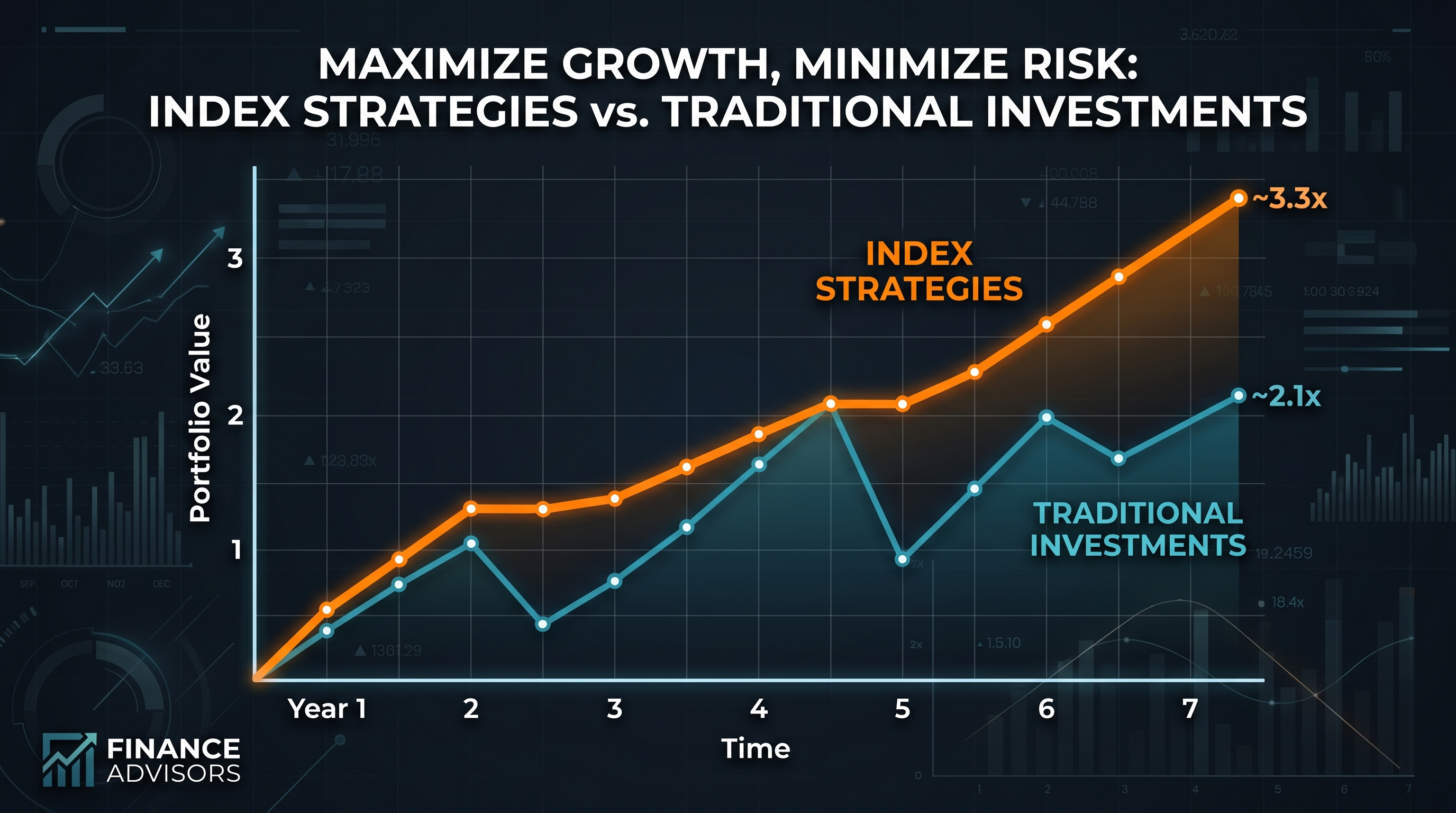
Index Strategies provide S&P 500-linked growth with a guaranteed zero-loss floor, meaning you participate in market gains up to a cap while never losing principal during downturns. At Everence Wealth, we help families understand how Zero is Your Hero protection allows compound growth from a fully protected base, eliminating the recovery gap traditional investors face after market corrections.
When most people think about retirement planning, they picture the traditional path: contribute to a 401(k), watch it grow with the market, and hope the balance is sufficient when retirement arrives. But there's a fundamental flaw in this approach that Wall Street rarely discusses—the devastating impact of market volatility on long-term compound growth. A single significant downturn can erase years of gains and require extraordinary returns just to break even. This is where Index Strategies fundamentally change the retirement equation by offering something traditional investments cannot: participation in S&P 500 growth with absolute protection against loss.
The mechanics of how Index Strategies work represent a paradigm shift in retirement planning. Unlike mutual funds, exchange-traded funds, or direct stock market investments that expose you to full downside risk, Index Strategies use a crediting mechanism that tracks S&P 500 performance up to an annual cap rate while guaranteeing your principal never decreases due to market losses. This isn't a hedging strategy or stop-loss mechanism—it's a contractual guarantee built into the policy structure itself. When the S&P 500 rises, you capture gains up to your cap. When it falls, your account value remains unchanged, and you begin the next year from your full principal base.
As an independent broker working with 75+ carriers across all 50 states, I've seen countless families discover Index Strategies after decades of exposure to unnecessary volatility risk. The realization that they could have been growing wealth without the anxiety of market crashes—without the sleepless nights during corrections, without the forced recovery periods—transforms how they think about financial security. This article provides a complete technical and strategic breakdown of Index Strategy mechanics, including floor-cap structures, annual reset mechanisms, S&P 500 comparison frameworks, tax advantages, and the mathematical superiority of protected compounding over traditional market exposure.
What Is an Index Strategy and How Does It Differ from Direct Market Investment?
An Index Strategy is a financial instrument that credits interest based on the performance of a market index—most commonly the S&P 500—while contractually guaranteeing that your principal and previously credited gains are protected from market downturns. The strategy operates through what's known as indexed crediting, where your account value is linked to index movement without directly investing in the underlying securities. This creates a fundamental asymmetry: you participate in market growth but are insulated from market loss. The insurance carrier manages the underlying investments and uses options strategies to fund the crediting mechanism while maintaining reserves to guarantee the floor protection.
The critical distinction from direct market investment lies in the risk-return profile. When you invest directly in the S&P 500 through an index fund or ETF, you receive the full upside of market gains but also absorb the full impact of market declines. If the S&P 500 rises 15%, you gain 15%. If it drops 30%, you lose 30% and must generate a 43% return just to recover to breakeven. Index Strategies eliminate this recovery requirement entirely. With a guaranteed 0% floor, a 30% market decline results in zero loss to your account value. You maintain your full principal base and capture the next market recovery from a protected position, compounding from strength rather than weakness.
This protection comes with a tradeoff: participation caps. Most Index Strategies offer annual cap rates ranging from 10% to 14%, depending on current interest rate environments and carrier offerings. If the S&P 500 gains 25% in a year, your account might be credited 12% based on your specific cap rate. However, the mathematical advantage becomes clear when analyzing full market cycles. Over a 30-year retirement accumulation period that includes multiple corrections, recessions, and bear markets, the elimination of negative return years often produces superior results compared to fully exposed portfolios, even with participation caps. The power of never going backward compounds dramatically over decades.
The S&P 500 vs Index Strategy Framework: Understanding Floor-Cap Mechanics
The S&P 500 has historically delivered strong long-term returns—approximately 10% annually over the past several decades—but with full exposure to market losses that can devastate retirement accounts at precisely the wrong time. Index Strategies track S&P 500 performance up to a cap rate, while a guaranteed floor ensures you never lose principal when the market drops. You participate in the growth. You are protected from the loss. This creates what we call asymmetric return profiles: limited upside in exchange for eliminated downside.
Consider the mathematical reality of market recovery. If you have $500,000 invested directly in the S&P 500 and the market drops 30%, your account falls to $350,000. To return to your original $500,000, you don't need a 30% gain—you need a 43% gain because you're now working from a reduced base. If the recovery takes three years at 12% annual returns, you've lost nearly four full years of compound growth. An Index Strategy investor with the same $500,000 experiences zero loss during the 30% decline. When the market recovers, they capture the upside gains from their full $500,000 base, immediately compounding from a position of strength rather than recovery.
This is the essence of Zero is Your Hero protection. Your worst year is 0%, not negative. Over a 35-year accumulation period, eliminating just two or three major market corrections can produce hundreds of thousands of dollars in additional wealth, even when accounting for participation caps during strong bull market years. The floor-cap mechanism isn't about outperforming the S&P 500 in every individual year—it's about building sustainable, protected wealth that compounds from a permanently rising floor, never giving back gains to market volatility.
S&P 500 vs Index Strategy: Protected Participation in Market Growth
The S&P 500 has historically delivered strong long-term returns, but with full exposure to market losses. Index Strategies track S&P 500 performance up to a cap rate, while a guaranteed floor ensures you never lose principal when the market drops. You participate in the growth. You are protected from the loss. If the S&P 500 drops 30%, a traditional investor loses 30% and needs a 43% gain just to break even. An Index Strategy investor loses 0% and captures the next market recovery from their full principal—compounding from a protected base. This is what we call Zero is Your Hero: your worst year is always 0%, never negative. Annual reset mechanisms lock in gains each year, creating a permanently rising floor that protects not just your original principal but all previously credited growth.
How the Annual Reset Mechanism Locks In Gains and Protects Your Upside
One of the most powerful features of Index Strategies is the annual reset mechanism, which fundamentally changes how gains are protected over time. Each year on your policy anniversary, any credited gains are locked into your account value permanently. This new higher value becomes your protected floor for the following year. Unlike traditional investments where unrealized gains can evaporate during market corrections, Index Strategy gains are contractually guaranteed once credited. This creates a ratcheting effect where your protected principal base increases every positive year, but never decreases during negative years.
The implications for long-term wealth building are profound. Imagine you start with $100,000 and experience a 12% credited gain in year one (based on S&P 500 performance and your policy cap). Your account value rises to $112,000, and this becomes your new protected floor. In year two, if the S&P 500 drops 20%, your account value remains $112,000—not only is your original principal protected, but your year-one gains are protected as well. In year three, when the market recovers and gains 18%, you're credited up to your cap from the $112,000 base, not from a reduced value. This compounding from a permanently rising floor is the mathematical engine that drives Index Strategy performance.
Traditional investors face constant give-and-take with market volatility. They gain 20% one year, lose 15% the next, gain 10%, lose 8%, and so on. The constant erosion and recovery creates inefficiency in compound growth. Index Strategy investors gain during positive years and maintain during negative years, creating uninterrupted compound progression. Over multiple decades, this difference becomes exponential. The annual reset isn't just a protection feature—it's a wealth acceleration mechanism that eliminates the mathematical drag of volatility while maintaining participation in market growth cycles.
Tax Advantages: How Index Strategies Fit Within the Three Tax Buckets Framework
Understanding where Index Strategies fit within your overall tax strategy is essential for maximizing retirement income efficiency. At Everence Wealth, we teach the Three Tax Buckets framework: Taxable, Tax-Deferred, and Tax-Exempt. Most Americans have concentrated their retirement savings almost entirely in tax-deferred accounts like 401(k)s and traditional IRAs, creating massive tax exposure during retirement when Required Minimum Distributions force ordinary income recognition at potentially the highest rates of your lifetime. Index Strategies, structured properly, can provide tax-exempt access to cash value, creating critical diversification across tax treatment.
Tax-deferred buckets include traditional 401(k)s, traditional IRAs, 403(b)s, and similar qualified retirement accounts. Contributions reduce current taxable income, growth is tax-deferred, but every dollar withdrawn in retirement is taxed as ordinary income. Additionally, Required Minimum Distributions beginning at age 73 force withdrawals whether you need the income or not, potentially pushing you into higher tax brackets and increasing Medicare premiums through Income-Related Monthly Adjustment Amounts. The tax liability is simply delayed, not eliminated, and often grows larger over time as accounts appreciate.
Tax-exempt buckets include Roth IRAs, Roth 401(k)s, and properly structured Index Strategies. With Index Strategies, you access accumulated cash value through policy loans that are not considered taxable distributions under current tax code. These loans are not reported as income, don't trigger tax consequences, don't affect Social Security taxation calculations, and don't impact Medicare premium brackets. This creates enormous flexibility in retirement income planning. You can strategically choose which bucket to draw from each year based on your tax situation, managing your effective tax rate and preserving more wealth for lifetime use and legacy transfer. The ability to access six-figure annual income streams without creating taxable events is a strategic advantage traditional retirement accounts simply cannot provide.
Index Strategies vs 401(k): Comparing Retirement Accumulation Approaches
The comparison between Index Strategies and 401(k) plans reveals fundamental differences in how wealth accumulates, how it's protected, and how it's accessed during retirement. A 401(k) provides upfront tax deduction, potential employer matching, and tax-deferred growth, but exposes you to full market volatility, locks funds until age 59½ without penalty exceptions, and creates mandatory taxable distributions starting at age 73. An Index Strategy provides no upfront tax deduction and typically no employer contribution, but offers S&P 500-linked growth with zero-loss protection, flexible access to cash value at any age without penalties, and tax-exempt income potential through policy loans.
From a pure accumulation standpoint, the question becomes whether the 401(k)'s employer match and upfront tax deduction outweigh the Index Strategy's volatility protection and tax-free access. For many families we work with, the answer is to use both strategically. Contribute enough to the 401(k) to capture full employer match—this is free money that shouldn't be left on the table. Beyond the match, additional retirement savings can flow into Index Strategies, creating tax diversification and downside protection that complements the tax-deferred bucket. This approach builds three-dimensional retirement security: growth potential from the 401(k), protection and tax-free access from the Index Strategy, and flexibility to manage tax exposure across both buckets.
The retirement income phase reveals even starker contrasts. 401(k) withdrawals are fully taxable as ordinary income, subject to Required Minimum Distributions, and reduce your account balance permanently with each distribution. If you withdraw $50,000 annually from a 401(k) in a 25% effective tax bracket, you net $37,500 and your account is reduced by the full $50,000. Index Strategy policy loans allow you to access $50,000 in cash value, receive the full $50,000 tax-free, while the policy's death benefit ensures the loan is repaid from the death benefit proceeds rather than requiring repayment during your lifetime. Your cash value continues receiving credited interest on the full amount, and your heirs receive the remaining death benefit tax-free. This creates superior income efficiency and legacy preservation compared to systematic 401(k) withdrawals.
Protection During Market Crashes: Real-World Performance in Down Markets
The true value of Index Strategy floor protection becomes clear during market crashes, when traditional portfolios suffer devastating losses and retirees face sequence-of-returns risk that can permanently impair their financial security. During the 2008 financial crisis, the S&P 500 declined approximately 37% from peak to trough. Investors who had $1,000,000 in index funds saw their accounts fall to $630,000. Those same investors then needed a 59% return just to recover to breakeven—a recovery that took years and only benefited those who could emotionally withstand the volatility without panic selling.
Index Strategy holders experienced that same period with zero account value decline. Their $1,000,000 remained $1,000,000, and when markets recovered in subsequent years, they captured the upside gains from their full principal base. The psychological and financial advantage of this protection cannot be overstated. Protection from loss isn't just about preserving account value—it's about eliminating the recovery requirement that steals years of compound growth. Every year spent recovering from losses is a year you're not actually growing wealth. Every dollar lost requires more than a dollar of gain to replace due to the mathematics of percentage returns from reduced bases.
The COVID-19 market crash of March 2020 provided another real-world case study. The S&P 500 dropped approximately 34% in just over a month. Traditional investors faced massive losses and extreme uncertainty. Index Strategy holders, once again, experienced zero loss. When the rapid recovery occurred through the remainder of 2020 and into 2021, they participated in those gains from their protected floor. This pattern repeats across every market cycle: dot-com crash, financial crisis, COVID crash, and future corrections yet to come. The guaranteed floor isn't theoretical protection—it's contractual certainty that transforms the retirement accumulation experience from volatility-induced anxiety to protected, predictable growth.
Who Should Consider an Index Strategy? Ideal Candidates and Strategic Use Cases
Index Strategies are particularly well-suited for individuals and families who have maximized tax-deferred retirement contributions, seek additional retirement savings vehicles with downside protection, want tax-free income options during retirement, or are concerned about sequence-of-returns risk as they approach retirement age. High-income professionals who have contributed the maximum to 401(k)s and IRAs but want additional tax-advantaged savings find Index Strategies provide a powerful complement to qualified plans. Business owners seeking asset protection, tax diversification, and flexible access to capital also benefit significantly from the Index Strategy structure.
Conservative investors who have been burned by market volatility or who simply cannot tolerate the emotional stress of watching account values fluctuate represent ideal candidates. If you've ever checked your retirement account during a market correction and felt genuine anxiety about your financial future, you understand the psychological cost of volatility. Index Strategies eliminate that anxiety by contractually guaranteeing your downside while maintaining meaningful participation in market growth. This emotional benefit has real financial value—investors who panic sell during downturns crystallize losses and miss subsequent recoveries, dramatically impairing long-term results. Protection from loss is also protection from emotional decision-making.
Individuals approaching retirement within 5-10 years face particularly acute sequence-of-returns risk. A significant market decline in the years immediately before or after retirement can devastate a portfolio precisely when recovery time is limited. Index Strategies provide a solution by offering market-linked growth without the catastrophic downside risk that threatens retirement security. By reallocating a portion of traditional retirement assets into Index Strategies during the pre-retirement window, you can reduce sequence risk while maintaining growth potential. At Everence Wealth, we stress-test retirement plans across multiple scenarios to identify optimal Index Strategy allocation based on individual circumstances, tax situations, and retirement timelines.
How to Evaluate Index Strategy Offerings: Key Policy Features and Carrier Comparison
Not all Index Strategies are created equal, and understanding the key policy features that differentiate offerings is essential for making informed decisions. As an independent broker with access to 75+ carriers, I evaluate Index Strategies based on several critical criteria: current cap rates, floor guarantees, participation rate structures, available index options beyond the S&P 500, policy fee structures, cash value accumulation speed, death benefit options, and carrier financial strength ratings. Each of these variables impacts long-term performance and suitability for specific planning objectives.
Current cap rates vary significantly across carriers and are influenced by the interest rate environment. In higher interest rate periods, carriers can offer more attractive caps—sometimes 12-14% or higher. In lower rate environments, caps may compress to 9-11%. However, focusing exclusively on the highest current cap can be misleading. Look at the carrier's historical cap rate stability, their cap rate reset methodology, and whether they offer cap rate floors or multi-year rate locks. Some policies guarantee minimum cap rates, providing certainty about worst-case crediting scenarios. Others offer indexed account options with participation rates instead of caps, or volatility-controlled indexes that may provide different risk-return profiles.
Policy fees and charges directly impact net cash value accumulation and should be evaluated in the context of overall value. Premium loads, monthly policy charges, cost of insurance rates, and surrender charge schedules all affect how much of your premium translates into cash value growth. Well-structured Index Strategies from highly-rated carriers typically show strong cash value accumulation beginning in years 10-15, with the policy becoming increasingly efficient as cash value grows and coverage becomes more cost-effective. Comparing illustrated values across multiple carriers requires understanding these fee structures and how they interact with credited interest over time. This is where working with an independent broker provides enormous value—we can objectively compare offerings across dozens of carriers to identify the most competitive structures for your specific situation.
About Steven Rosenberg & Everence Wealth
Steven Rosenberg is the Founder and Chief Wealth Strategist at Everence Wealth, a San Francisco-based independent financial firm serving families and business owners across all 50 states. As an independent broker with partnerships across 75+ insurance carriers, Steven specializes in Index Strategies, tax-efficient retirement planning, and wealth protection frameworks that challenge conventional Wall Street wisdom. His expertise centers on helping clients understand the mathematical realities of fees, volatility, and taxes—what he calls the Three Silent Killers of wealth—and implementing strategies that protect principal while capturing market-linked growth. Steven's educational approach focuses on frameworks like Zero is Your Hero, the Three Tax Buckets, and S&P 500 vs Index Strategy comparisons that empower clients to make informed decisions based on their unique circumstances. Unlike captive agents who represent a single insurance company or commission-driven advisors with product quotas, Steven operates exclusively as an independent broker, working in the client's best interest to identify optimal solutions from the broadest possible universe of carriers and strategies. His work with Everence Wealth represents a commitment to transparency, education, and long-term relationships built on delivering protected, tax-efficient growth that withstands market volatility and tax code changes across multi-decade retirement timelines.
Discover How Index Strategies Can Protect and Grow Your Retirement Wealth
Understanding how Index Strategies work is the first step toward building a retirement plan that captures S&P 500 growth without the sleepless nights of market volatility. At Everence Wealth, we provide comprehensive Financial Needs Assessments that analyze your current retirement trajectory, stress-test your portfolio against market corrections and tax exposure, and identify specific opportunities to implement Index Strategies within your overall wealth plan. Whether you're maximizing 401(k) contributions and seeking additional tax-advantaged growth, approaching retirement and concerned about sequence-of-returns risk, or simply exhausted by market volatility, a Financial Needs Assessment provides clarity, quantification, and actionable strategies tailored to your unique situation. Schedule your complimentary assessment today and discover how Zero is Your Hero protection can transform your retirement security.
Schedule Your Financial Needs AssessmentThis content is for educational purposes only and does not constitute financial, tax, or legal advice. Index Strategy performance depends on specific policy provisions, carrier financial strength, and individual circumstances. Past performance of market indexes does not guarantee future results. Consult a licensed professional before making any financial decisions.