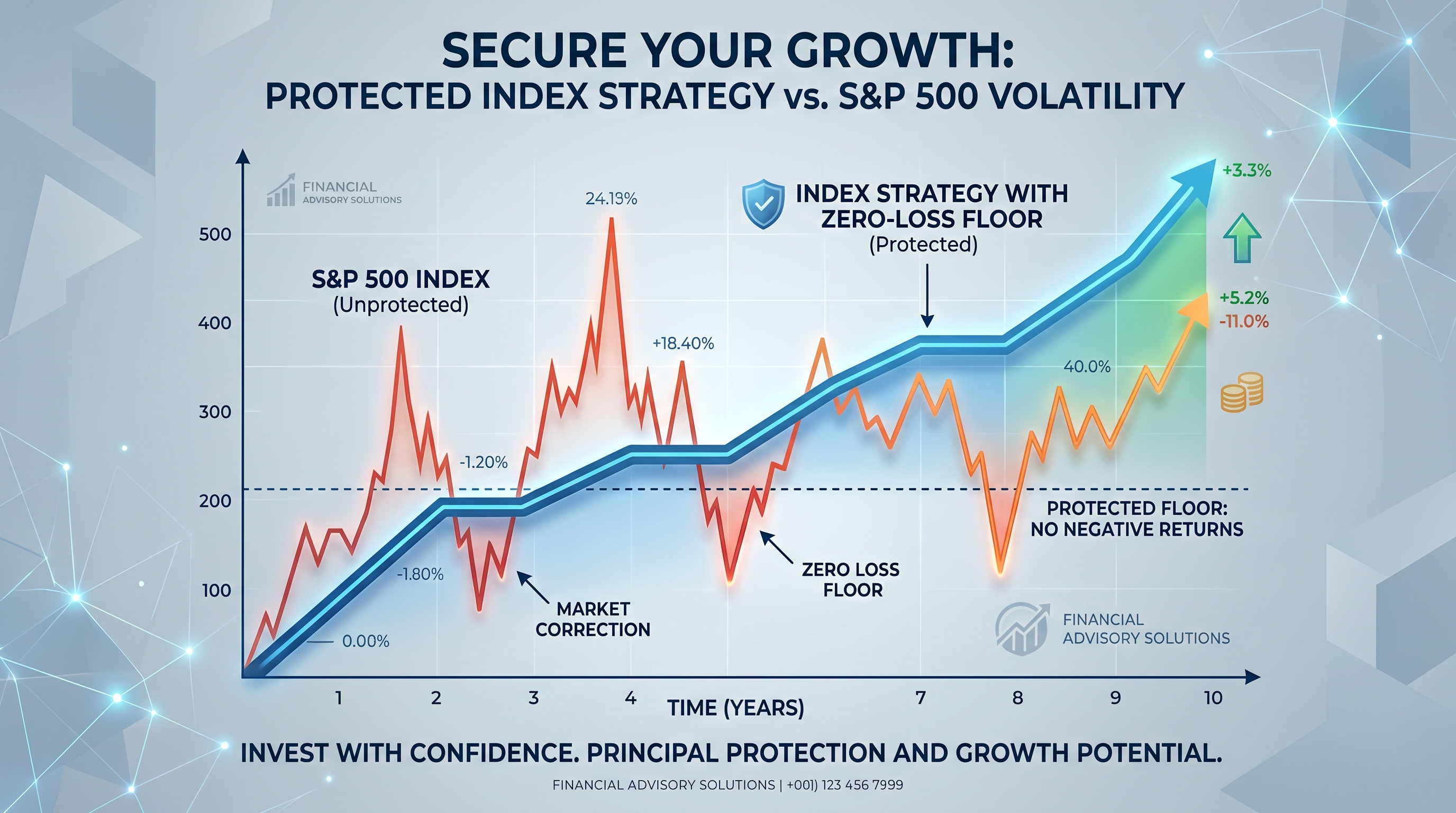
Index Strategies allow you to participate in S&P 500 market gains up to a cap rate while protecting your principal with a guaranteed zero-loss floor. Unlike traditional market investments that expose you to full downside volatility, Index Strategies ensure your worst year is 0%. At Everence Wealth, we help families leverage this S&P 500 vs Index Strategy framework to build tax-efficient retirement income while eliminating sequence-of-returns risk through protected compounding.
Most Americans understand the S&P 500 has delivered approximately 10% average annual returns over the long term. What they don't understand is how market volatility systematically destroys wealth through the compounding damage of losses. A 30% market decline requires a 43% gain just to break even. A 50% loss demands a 100% recovery. The math is unforgiving, and the psychological toll of watching retirement accounts plummet often leads investors to sell at the worst possible moment. This volatility drag represents one of the most underestimated threats to sustainable retirement income, yet few financial professionals address it with mathematical precision.
Index Strategies solve this fundamental problem by linking your growth potential to the S&P 500 while establishing a contractual zero-loss floor that protects every dollar of principal and previously credited gains. You participate in market upside up to an annual cap rate, typically ranging from 10% to 14% depending on carrier and product design. When the market drops, your account value remains unchanged. Your worst year is 0%, never negative. This asymmetric return profile eliminates the recovery gap that devastates traditional portfolios during bear markets, allowing you to compound from a protected base year after year. The strategy is particularly powerful for pre-retirees and retirees who cannot afford sequence-of-returns risk in the critical decade surrounding retirement.
At Everence Wealth, we've spent years educating families on how Index Strategies function as the foundation of tax-efficient retirement planning. As an independent broker with partnerships across 75+ insurance carriers, we work exclusively in your best interest to design strategies that capture S&P 500 growth while protecting against the three silent killers of retirement wealth: fees, volatility, and taxes. This comprehensive guide explains exactly how Index Strategies work, why the S&P 500 comparison matters, and how the zero-floor mechanism transforms long-term wealth accumulation through what we call Zero is Your Hero.
What Is an Index Strategy and How Does It Track the S&P 500?
An Index Strategy is a financial product, typically structured as an Indexed Universal Life insurance policy or Fixed Indexed Annuity, that credits interest based on the performance of an external market index, most commonly the S&P 500. The strategy does not involve direct investment in the stock market. Instead, the insurance carrier invests your premium dollars into its general account, which holds primarily investment-grade bonds and fixed-income instruments. The carrier then uses a portion of the bond yield to purchase option contracts on the S&P 500, which provide the upside participation you receive when the index performs well.
This structure is critical to understanding both the protection and the participation. Because your money is not directly invested in stocks, you are insulated from market losses. The insurance carrier guarantees your principal through its general account reserves and state insurance guaranty associations. When the S&P 500 rises, the gains from the option contracts are credited to your policy up to a predetermined cap rate. When the S&P 500 falls, the options expire worthless, but your principal remains intact. The carrier absorbs the cost of the downside protection, which is why there is a cap on the upside. This is the fundamental tradeoff: you surrender unlimited upside potential in exchange for complete downside protection and tax-advantaged growth.
The annual reset mechanism is what makes this strategy particularly powerful for long-term compounding. Each policy anniversary, your gains lock in and become the new protected floor for the following year. If you earn 12% in year one, that 12% gain cannot be taken away by a market decline in year two. Your account value only moves sideways at 0% or upward within the cap. Over decades, this ratcheting effect creates a smoother growth trajectory than traditional market investing, eliminating the devastating psychological and mathematical impact of large drawdowns. In our experience stress-testing portfolios through multiple market cycles, this protected compounding advantage often results in comparable or superior long-term outcomes relative to direct S&P 500 exposure, particularly when accounting for behavioral factors and the timing of withdrawals.
The S&P 500 vs Index Strategy Framework: Participation Without Devastation
The S&P 500 has historically delivered strong long-term returns, but with full exposure to market losses. Direct S&P 500 investors experienced a 37% decline in 2008, a 34% drop in the first quarter of 2020, and numerous corrections exceeding 20% throughout history. Each of these events created permanent capital destruction for investors who panicked and sold, or who were forced to liquidate during retirement to fund living expenses. Index Strategies track S&P 500 performance up to a cap rate, while a guaranteed floor ensures you never lose principal when the market drops. You participate in the growth. You are protected from the loss.
If the S&P 500 drops 30%, a traditional investor loses 30% and needs a 43% gain just to break even. An Index Strategy investor loses 0% and captures the next market recovery from their full principal, compounding from a protected base. This is what we call Zero is Your Hero. The mathematical advantage becomes even more pronounced during sequence-of-returns scenarios, where the timing of gains and losses dramatically impacts long-term wealth. A retiree who experiences negative returns in the first five years of retirement can see their portfolio depleted by 40% to 60% compared to an identical return sequence in reverse order. Index Strategies eliminate this risk entirely by preventing negative return years from entering the equation.
Consider two investors, each starting with $500,000. Investor A is fully invested in the S&P 500. Investor B uses an Index Strategy with a 12% cap and 0% floor. Over a 10-year period, the S&P 500 experiences the following annual returns: +15%, -25%, +30%, +10%, -15%, +20%, +8%, -10%, +12%, +18%. Investor A ends with approximately $674,000, enduring significant volatility and psychological stress. Investor B, capturing gains up to the 12% cap and experiencing 0% in down years, ends with approximately $655,000 through protected compounding, but with zero sleepless nights, zero panic selling, and zero sequence-of-returns risk if withdrawals are needed. The performance gap narrows considerably, and when you factor in tax treatment and behavioral advantages, the Index Strategy often proves superior in real-world implementation.
S&P 500 vs Index Strategy: Protected Participation
The S&P 500 has historically delivered strong long-term returns, but with full exposure to market losses. Index Strategies track S&P 500 performance up to a cap rate, while a guaranteed floor ensures you never lose principal when the market drops. You participate in the growth. You are protected from the loss. If the S&P 500 drops 30%, a traditional investor loses 30% and needs a 43% gain just to break even. An Index Strategy investor loses 0% and captures the next market recovery from their full principal, compounding from a protected base. This is what we call Zero is Your Hero. The floor-cap mechanic works through option contracts purchased by the insurance carrier using bond yields from the general account. When the index rises, option gains are credited up to the cap. When the index falls, options expire worthless but your principal is contractually protected. The annual reset locks in gains each year, creating a ratcheting effect that eliminates recovery gaps and sequence-of-returns risk. This asymmetric return profile is particularly valuable during the retirement red zone, the critical decade before and after retirement when portfolio volatility can permanently impair your ability to generate sustainable income.
How the Zero-Loss Floor Protects Your Retirement from Market Crashes
The zero-loss floor is the contractual guarantee that your policy's cash value will never decline due to negative index performance. This guarantee is backed by the insurance carrier's general account reserves, which are invested in highly rated bonds and fixed-income securities, and further protected by state insurance guaranty associations. In the event of carrier insolvency, which is extraordinarily rare given the regulatory capital requirements and conservative investment mandates imposed on life insurance companies, state guaranty associations provide coverage up to statutory limits, typically $250,000 to $500,000 depending on the state and coverage type.
This floor protection operates independently of market conditions. During the 2008 financial crisis, when the S&P 500 plummeted 37%, Index Strategy holders saw their account values remain flat. During the March 2020 COVID crash, when the S&P 500 dropped 34% in 23 trading days, Index Strategy holders experienced 0% loss. The psychological and financial value of this protection cannot be overstated. Behavioral finance research consistently demonstrates that investors who experience large losses are far more likely to abandon their investment strategies at precisely the wrong moment, locking in permanent capital destruction. By eliminating downside volatility, Index Strategies remove the emotional triggers that lead to catastrophic decision-making.
The floor also creates powerful tax advantages when structured within a properly designed Indexed Universal Life policy. Because policy loans are classified as debt rather than distributions, you can access your cash value during retirement without triggering taxable events, effectively creating tax-free retirement income. This is particularly valuable in high-tax states like California, New York, and New Jersey, where combined federal and state marginal rates can exceed 50%. When you combine the zero-loss floor with tax-free access, you create a retirement income stream that is both protected from market volatility and insulated from tax volatility, giving you complete control over your retirement cash flow regardless of what Congress does with future tax legislation.
Understanding Cap Rates, Participation Rates, and Crediting Methods
Index Strategies offer several different crediting methods that determine how index gains are calculated and applied to your policy. The most common method is the annual point-to-point with cap, which measures the index value at the beginning and end of the policy year and credits the percentage gain up to the stated cap rate. If the S&P 500 gains 15% and your cap is 12%, you receive 12%. If the S&P 500 gains 8%, you receive 8%. If the S&P 500 loses any amount, you receive 0%. This method is straightforward and provides excellent downside protection with meaningful upside participation.
Another popular method is the monthly average, which calculates the average of the monthly index values throughout the year and compares it to the starting value. This method typically offers higher cap rates or uncapped participation because it naturally dampens volatility through the averaging calculation. Monthly average crediting can be advantageous in trending markets but may underperform point-to-point in years with strong late-year rallies. Some carriers also offer participation rates instead of caps, where you receive a stated percentage of the index gain, such as 100% participation up to a cap, or 150% participation with no cap but subject to a spread or fee.
Cap rates are not guaranteed for the life of the policy. Carriers adjust caps annually based on bond yields, option costs, and competitive positioning. Current cap rates typically range from 10% to 14% for annual point-to-point strategies, though some specialized products offer higher caps with trade-offs in other policy features. It's critical to work with an independent broker who can stress-test multiple carriers and product designs to identify the optimal combination of floor, cap, crediting method, fees, and death benefit for your specific situation. At Everence Wealth, we model scenarios across 30+ year time horizons to ensure your Index Strategy performs efficiently under a wide range of market conditions and interest rate environments.
Tax Advantages: Building the Tax-Exempt Bucket with Index Strategies
One of the most powerful features of Index Strategies, particularly when structured as Indexed Universal Life policies, is their position within the Tax-Exempt bucket of the Three Tax Buckets framework. The Three Tax Buckets represent the three ways the IRS taxes retirement income: Taxable accounts where you pay taxes on interest, dividends, and capital gains annually; Tax-Deferred accounts like 401(k)s and IRAs where you postpone taxes until withdrawal, typically in retirement when Required Minimum Distributions force taxable events; and Tax-Exempt accounts like Roth IRAs and properly structured life insurance where growth and distributions occur entirely tax-free.
Index Strategies within Indexed Universal Life policies offer distinct advantages over Roth IRAs in several key areas. First, there are no income limitations—high earners who are phased out of Roth contributions can fund Index Strategies without restriction. Second, there are no contribution limits beyond the Modified Endowment Contract testing requirements, allowing you to fund six-figure annual premiums if your situation warrants. Third, there are no Required Minimum Distributions at age 73, giving you complete control over the timing and amount of your retirement income. Fourth, policy loans provide tax-free access to cash value without the early withdrawal penalties that apply to Roth IRA distributions before age 59½.
The tax-free loan structure is the key mechanism that makes Index Strategies a tax-exempt income source. When you need retirement income, you borrow against your policy's cash value using the insurance carrier's money. The loan is collateralized by your death benefit, not your cash value, so your money continues to grow and earn index credits even while you're using it to fund retirement expenses. You never repay the loan during your lifetime. Upon death, the loan balance is simply deducted from the death benefit, and the remaining death benefit passes income-tax-free to your beneficiaries. This creates a tax arbitrage opportunity where you're earning index-linked returns on the full cash value while borrowing at competitive loan rates, often in wash-loan or participating-loan designs that minimize or eliminate net loan costs.
Index Strategies vs Traditional 401(k) and IRA Accounts
Traditional 401(k)s and IRAs operate in the Tax-Deferred bucket, meaning you receive a tax deduction on contributions but pay ordinary income tax on every dollar withdrawn in retirement. For high-income professionals in states like California, this can result in a combined federal and state tax rate exceeding 50% on distributions. Additionally, these accounts are subject to Required Minimum Distributions starting at age 73, forcing you to take taxable withdrawals whether you need the income or not, potentially pushing you into higher tax brackets and triggering Medicare premium surcharges through IRMAA provisions.
Index Strategies eliminate all of these tax burdens. Your contributions are made with after-tax dollars, so there's no upfront deduction, but all growth occurs tax-deferred and all retirement income accessed through policy loans is tax-free. This creates significant long-term value when tax rates rise or when you need flexibility to manage your taxable income in retirement. For example, if you're considering a Roth conversion strategy to reduce future RMD exposure, having tax-free income available from an Index Strategy allows you to fill up lower tax brackets with conversion income without pushing yourself into higher brackets, maximizing the efficiency of the conversion.
The lack of contribution limits and income restrictions makes Index Strategies particularly valuable for business owners, executives, and high-income professionals who have maximized their qualified plan contributions but need additional tax-advantaged retirement savings vehicles. We frequently work with clients who are contributing the maximum $23,000 to their 401(k), plus $7,500 in catch-up contributions, but recognize that $30,500 per year is woefully inadequate to replace a $300,000 to $500,000 annual income stream in retirement. Index Strategies allow these clients to save an additional $50,000 to $150,000 annually in a vehicle that provides S&P 500-linked growth, downside protection, tax-free income, and estate planning benefits through the income-tax-free death benefit.
Real-World Implementation: Who Benefits Most from Index Strategies?
Index Strategies are particularly well-suited for specific financial profiles and planning objectives. Pre-retirees aged 45 to 65 who are in their peak earning years and focused on building tax-efficient retirement assets represent the ideal demographic. These individuals typically have maximized their qualified plan contributions, have 15 to 25 years until retirement to allow the strategy to mature, and are increasingly concerned about sequence-of-returns risk as they approach the retirement red zone. Index Strategies provide protected growth during the accumulation phase and tax-free income during the distribution phase, solving both problems simultaneously.
Business owners who are building tax-advantaged exit strategies also benefit significantly from Index Strategies. When you sell a business, the resulting tax liability can be devastating if not properly managed. By building cash value in an Index Strategy over the 5 to 10 years leading up to a business sale, you create a tax-free income source that allows you to defer or avoid liquidating taxable investment accounts to fund retirement expenses. Additionally, the death benefit provides income-tax-free legacy wealth to your heirs, effectively creating a self-completing estate plan that doesn't depend on volatile markets or complex trust structures.
High-income professionals in expensive coastal states where combined tax rates exceed 50% should prioritize Index Strategies as a core component of their retirement planning. The tax-free income benefit is exponentially more valuable when your marginal tax rate is higher. A $50,000 tax-free distribution from an Index Strategy is the economic equivalent of an $83,000 to $100,000 taxable distribution from a 401(k) or IRA when you're in the highest tax brackets. Over a 30-year retirement, this tax savings can amount to seven figures, money that remains in your family instead of being transferred to the IRS and state tax authorities. This is precisely the type of long-term strategic thinking that separates sustainable multigenerational wealth from strategies that simply kick the tax can down the road.
About Steven Rosenberg & Everence Wealth
Steven Rosenberg is the Founder and Chief Wealth Strategist at Everence Wealth, a San Francisco-based independent insurance brokerage specializing in tax-efficient Index Strategies, retirement planning, and asset protection for families and business owners across all 50 states. As an independent broker with partnerships across 75+ insurance carriers, Steven works exclusively in the client's best interest, providing access to institutional-grade strategies without the conflicts of interest inherent in captive agent or wirehouse broker models. His expertise centers on the S&P 500 vs Index Strategy framework, helping clients capture market-linked growth with zero-loss floors while building tax-free retirement income through properly structured Indexed Universal Life policies and Fixed Indexed Annuities. Steven is a licensed insurance professional who educates clients on the Three Tax Buckets framework, showing families how to diversify across Taxable, Tax-Deferred, and Tax-Exempt accounts to minimize lifetime tax exposure and maximize sustainable retirement cash flow. He specializes in stress-testing retirement plans against the Three Silent Killers—fees, volatility, and taxes—and designing comprehensive strategies that protect against sequence-of-returns risk, Required Minimum Distribution exposure, and estate tax inefficiencies. His approach combines mathematical rigor with practical implementation, using tools like the Rule of 72 to illustrate the devastating long-term impact of fee drag, and S&P 500 recovery math to demonstrate why Zero is Your Hero in protecting retirement assets from market crashes.
Schedule Your Financial Needs Assessment
Understanding how Index Strategies work is the first step toward building a tax-efficient, market-protected retirement plan. The next step is stress-testing your current strategy against fees, volatility, and taxes to identify gaps and opportunities. At Everence Wealth, we offer a comprehensive Financial Needs Assessment that analyzes your current retirement trajectory, evaluates your tax bucket diversification, quantifies your exposure to Required Minimum Distributions, and models how an Index Strategy could enhance your long-term wealth accumulation and retirement income. This assessment is complimentary, obligation-free, and designed to provide clarity on whether an Index Strategy aligns with your financial goals, risk tolerance, and timeline. As an independent broker with 75+ carrier partnerships, we have access to the full universe of Index Strategy products, allowing us to design a customized solution that optimizes floor protection, cap rates, death benefit, and tax efficiency specifically for your situation.
Schedule Your Financial Needs AssessmentThis content is for educational purposes only and does not constitute financial, tax, or legal advice. Index Strategy performance is not guaranteed and depends on carrier cap rates, crediting methods, fees, and index performance. Policy loans reduce cash value and death benefit if not repaid, and excessive loans can cause policy lapse. Consult a licensed insurance professional and tax advisor before making any financial decisions.