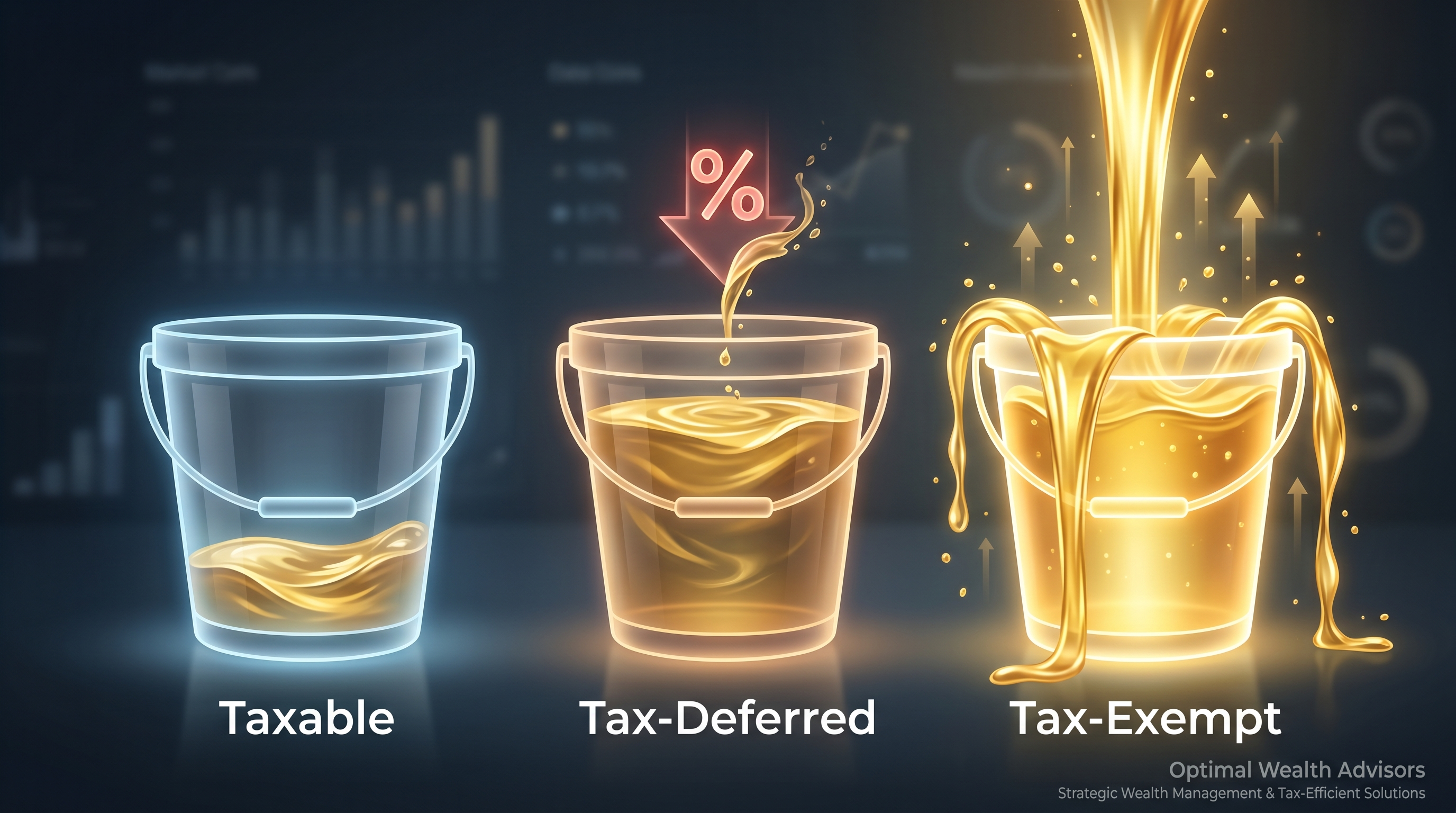
A tax-free retirement account, such as those built through Index Strategies or Roth IRAs, allows you to access retirement income without triggering federal income tax. Unlike 401(k)s and traditional IRAs where withdrawals are taxed as ordinary income, tax-free accounts provide distributions that bypass IRS taxation. Everence Wealth specializes in building Tax-Exempt bucket strategies using the Three Tax Buckets framework, ensuring sustainable retirement cash flow without RMD exposure or tax-bracket erosion.
The average American retiree loses between 22% and 37% of their retirement income to federal and state taxes. After decades of disciplined saving into 401(k)s and traditional IRAs, millions of families discover that Required Minimum Distributions force them into higher tax brackets at the exact moment they need maximum spending power. The promise of tax-deferred growth becomes a tax time bomb when distributions begin. This structural flaw in conventional retirement planning is not an accident—it is a design feature of the retail financial system that prioritizes Wall Street fee generation over retiree cash flow security.
Tax-free retirement accounts solve this problem by eliminating future tax liability entirely. Rather than deferring taxes and hoping for lower rates in retirement, tax-exempt strategies lock in tax-free distributions regardless of future tax law changes, income needs, or market conditions. The distinction between tax-deferred and tax-exempt is not semantic—it represents the difference between renting your retirement income from the IRS and owning it outright. For families seeking sustainable retirement cash flow, understanding how to build and maximize tax-free accounts is not optional. It is foundational.
At Everence Wealth, we specialize in building diversified retirement strategies across all Three Tax Buckets: Taxable, Tax-Deferred, and Tax-Exempt. Our approach as an independent broker with 75+ carrier partnerships allows us to design Index Strategy solutions that combine S&P 500-linked growth with zero-floor protection and tax-free distribution potential. This article explores the mechanics, benefits, and strategic implementation of tax-free retirement accounts, with particular focus on how Index Strategies deliver protected growth without the tax exposure inherent in traditional qualified plans.
What Qualifies as a Tax-Free Retirement Account?
A tax-free retirement account is any financial vehicle that allows you to access retirement income without incurring federal income tax on distributions. The two primary categories are Roth IRAs and properly structured Index Strategies (often built using Indexed Universal Life insurance policies). Both allow after-tax contributions to grow without annual tax drag and provide distributions that bypass ordinary income taxation. The key distinction lies in contribution limits, access rules, and downside protection mechanics.
Roth IRAs permit annual contributions up to $6,500 (or $7,500 if age 50 or older), with income phase-out limits that exclude high earners. Qualified distributions after age 59½ are entirely tax-free, provided the account has been open for at least five years. However, Roth IRAs offer no principal protection during market downturns. If the S&P 500 drops 30%, your Roth IRA drops 30%, and you must wait for full recovery before your account value returns to its prior peak. This volatility risk compounds the emotional and mathematical challenge of retirement distribution planning.
Index Strategies, by contrast, provide tax-free access through policy loans rather than taxable withdrawals. Because loans are not classified as income by the IRS, you can access your cash value without triggering taxation or Required Minimum Distribution (RMD) rules. Simultaneously, Index Strategies track S&P 500 performance up to a cap rate while maintaining a guaranteed zero-percent floor. Your worst year is 0%, not negative. This combination of tax-free access and downside protection creates a fundamentally different risk-reward profile compared to market-exposed Roth accounts.
We often explain this to clients using the S&P 500 vs Index Strategy framework: traditional Roth IRAs give you full S&P 500 upside and full downside. Index Strategies give you S&P 500 participation up to a cap with zero downside. You participate in the growth. You are protected from the loss. Zero is Your Hero. For families seeking tax-free retirement income without market risk exposure, this distinction is material.
How the Three Tax Buckets Framework Optimizes Retirement Income
Most retirement portfolios are dangerously overweight in the Tax-Deferred bucket. Decades of employer-sponsored 401(k) contributions, traditional IRA rollovers, and pension deferrals create a concentrated tax liability that detonates upon retirement. When RMDs begin at age 73, the IRS forces distributions whether you need the income or not, often pushing retirees into higher marginal brackets and triggering Medicare premium surcharges through IRMAA (Income-Related Monthly Adjustment Amount). This tax compression erodes purchasing power and limits strategic flexibility.
The Three Tax Buckets framework solves this by diversifying tax treatment across three categories. The Taxable bucket includes brokerage accounts, savings accounts, and non-qualified investments. Gains are taxed annually, but you control timing and can harvest losses strategically. The Tax-Deferred bucket includes 401(k)s, traditional IRAs, and SEP accounts. Contributions reduce current taxable income, but all distributions are taxed as ordinary income. The Tax-Exempt bucket includes Roth IRAs and Index Strategies. Contributions are made with after-tax dollars, but all future growth and distributions are entirely tax-free.
By building meaningful balances across all three buckets, you create distribution optionality. In low-income years, you can draw from tax-deferred accounts to fill lower brackets. In high-income years, you can draw from tax-exempt accounts to avoid bracket creep. If tax rates rise, your Tax-Exempt bucket becomes more valuable. If rates fall, your Tax-Deferred bucket becomes more efficient. This flexibility is the strategic advantage of bucket diversification. Without it, you are forced to accept whatever tax treatment the IRS imposes on your single-bucket portfolio.
In our experience stress-testing portfolios for families across all 50 states, we consistently find that households with at least 30% of retirement assets in the Tax-Exempt bucket experience significantly lower lifetime tax drag and greater distribution sustainability. The mathematical advantage compounds over 25 to 35 years of retirement, creating six-figure differences in after-tax spending power. Tax diversification is not a luxury—it is a structural necessity in a progressive tax system.
S&P 500 vs Index Strategy: Protected Participation
The S&P 500 has historically delivered strong long-term returns—but with full exposure to market losses. Index Strategies track S&P 500 performance up to a cap rate, while a guaranteed floor ensures you never lose principal when the market drops. You participate in the growth. You are protected from the loss. If the S&P 500 drops 30%, a traditional investor loses 30% and needs a 43% gain just to break even. An Index Strategy investor loses 0% and captures the next market recovery from their full principal base—compounding from a protected base. This is what we call Zero is Your Hero. For tax-free retirement accounts, combining tax exemption with principal protection creates a dual-layer risk mitigation framework: no market loss, no tax loss. This structural advantage is unavailable in traditional Roth IRAs, which offer tax exemption but full market exposure.
Why Tax-Free Accounts Outperform Tax-Deferred in High-Tax States
For residents of California, New York, New Jersey, Massachusetts, and other high-tax states, the advantage of tax-free retirement accounts is magnified. State income tax rates ranging from 9% to 13.3% compound federal tax exposure, creating combined marginal rates exceeding 50% for high earners. When RMDs force distributions from tax-deferred accounts, both federal and state taxes apply. A $100,000 RMD in California can trigger $50,000 in combined tax liability, leaving only $50,000 in spendable income.
Tax-free accounts eliminate this state tax exposure entirely. Roth IRA distributions and Index Strategy policy loans are not classified as taxable income at the federal level, which means most states also exclude them from state income calculations. This creates a 13.3% arbitrage opportunity in California, 10.9% in New Jersey, and 9% in Massachusetts. Over a 25-year retirement, this state tax savings alone can exceed $300,000 for a household distributing $60,000 annually from tax-exempt sources rather than tax-deferred.
We frequently advise clients in high-tax states to prioritize Tax-Exempt bucket contributions over additional Tax-Deferred contributions once employer match thresholds are met. The immediate tax deduction from 401(k) contributions is less valuable than the lifetime elimination of state and federal tax on distributions. This is particularly true for business owners and high-income professionals who face the highest marginal rates and receive the smallest proportional benefit from current-year deductions.
The strategic value of tax-free accounts increases further when you consider future tax risk. State budgets are under structural pressure from pension obligations and demographic shifts. Tax rates in high-tax states are more likely to rise than fall over the next 20 to 30 years. Locking in tax-free distribution rights today hedges against this legislative risk. You control the tax treatment of your retirement income regardless of future policy changes.
How Index Strategies Provide Tax-Free Retirement Income Without RMD Exposure
One of the most overlooked advantages of Index Strategies is the complete absence of Required Minimum Distribution rules. Unlike 401(k)s and traditional IRAs, which force distributions starting at age 73, Index Strategies have no mandatory withdrawal schedule. You access cash value when you choose, in the amount you choose, using policy loans that are not classified as taxable income. This control over distribution timing eliminates the forced taxation that undermines tax-deferred accounts.
Policy loans work by borrowing against your cash value rather than withdrawing it. The loan is collateralized by your death benefit, and you repay it on your own schedule—or not at all. Upon death, any outstanding loan balance is deducted from the death benefit, and the remaining amount passes income-tax-free to beneficiaries. Because the IRS does not classify loans as income, you avoid taxation entirely. This creates a functional equivalent to tax-free withdrawals without triggering the income recognition that applies to Roth distributions.
The cash value itself grows based on the performance of a selected index, typically the S&P 500, with annual reset protection. If the index gains 12% in a year, your cash value is credited up to the cap rate (commonly 10% to 12%). If the index drops 30%, your cash value is credited 0%—you lose nothing. These annual credits lock in, and your new higher base is protected in future years. This annual reset mechanic ensures that gains compound from a protected floor, eliminating the recovery drag that devastates market-exposed accounts after downturns.
For retirees seeking predictable, tax-free income without market volatility or forced distributions, Index Strategies offer a structural solution unavailable in any other vehicle. You combine the tax exemption of a Roth with the principal protection of a fixed account and the growth potential of equity indexing. This three-way convergence addresses the Three Silent Killers simultaneously: Fees (low-cost carrier structures), Volatility (zero-floor protection), and Taxes (tax-free loans).
Comparing Tax-Free Retirement Accounts: Roth IRA vs Index Strategy
Both Roth IRAs and Index Strategies provide tax-free retirement income, but their structural mechanics, contribution limits, and risk profiles differ significantly. Understanding these differences allows you to deploy each vehicle strategically within your overall Tax-Exempt bucket allocation. For many families, the optimal approach combines both: Roth IRAs for lower-income years and smaller balances, and Index Strategies for higher-income years, larger balances, and downside protection.
Roth IRAs have strict annual contribution limits ($6,500 or $7,500 if age 50+) and income phase-out thresholds that exclude high earners. Contributions are after-tax, growth is tax-deferred, and qualified distributions after age 59½ are entirely tax-free. However, Roth IRAs are fully exposed to market risk. If your portfolio is invested in equities and the market drops, your account value drops in lockstep. There is no principal protection, and you bear full sequence-of-returns risk during distribution years.
Index Strategies have no annual contribution limits beyond insurability and underwriting guidelines. You can fund six-figure or even seven-figure premium amounts in a single year, subject to IRS Modified Endowment Contract (MEC) rules. Growth is tax-deferred and linked to index performance with a zero-percent floor. Distributions via policy loans are tax-free and not subject to RMD rules. Downside protection ensures your worst year is 0%, and your death benefit provides tax-free wealth transfer to beneficiaries. However, Index Strategies have internal insurance costs and surrender charges in early years, making them long-term vehicles best suited for 15+ year time horizons.
The decision between Roth and Index Strategy contributions depends on income level, time horizon, risk tolerance, and Tax-Exempt bucket goals. High earners excluded from Roth contributions can use Index Strategies to build unlimited tax-free balances. Risk-averse retirees seeking principal protection benefit from Index Strategy floors. Younger savers with long time horizons may prioritize Roth simplicity and lower costs. At Everence Wealth, we design bucket strategies that layer both vehicles, optimizing for tax efficiency, risk mitigation, and distribution flexibility across all retirement phases.
| Feature | Index Strategy | Roth IRA |
|---|---|---|
| Market Downside Protection | Guaranteed 0% floor. Your worst year is zero, not negative. Annual reset locks in gains and protects new base from future downturns. You participate in S&P 500 growth up to cap while eliminating loss exposure entirely. | No downside protection. If the S&P 500 drops 30%, your Roth IRA drops 30%. You bear full market risk and must wait for complete recovery before your account value returns to prior peak. |
| Tax Treatment | Policy loans are not classified as income by the IRS, providing tax-free access without triggering ordinary income taxation or RMD requirements. Death benefit passes income-tax-free to beneficiaries. | Qualified distributions after age 59½ are entirely federal income-tax-free, provided the account has been open for at least five years. Contributions can be withdrawn anytime without penalty or tax. |
| Required Distributions | No RMD requirements at any age. You control distribution timing and amount. Access cash value through loans on your schedule without forced taxation or income recognition. | No RMD requirements during owner's lifetime. Beneficiaries must distribute inherited Roth IRAs within 10 years under SECURE Act rules, but distributions remain tax-free. |
| Access / Liquidity | Policy loans provide tax-free access to cash value at any age without penalty. Loans are repaid on your schedule or deducted from death benefit. Early surrender charges apply in first 10-15 years. | Contributions can be withdrawn anytime tax- and penalty-free. Earnings are subject to 10% penalty if withdrawn before age 59½ unless exception applies. No surrender charges. |
| Fees / Costs | Internal insurance costs and premium loads vary by carrier. Competitive carriers offer low-cost structures that minimize drag. No annual account fees or transaction costs. Cost structure is transparent and disclosed annually. | Custodial fees typically $0-$50 annually. Underlying investment expenses (mutual fund expense ratios) range from 0.05% to 1.5%. No insurance costs. Transaction costs depend on brokerage platform. |
| Estate Planning | Death benefit passes income-tax-free to beneficiaries, often providing multiples of cash value. Can be structured with irrevocable life insurance trusts (ILITs) to remove from taxable estate for estate tax purposes. | Roth IRA balances pass to beneficiaries income-tax-free but are included in taxable estate for estate tax purposes. Beneficiaries must distribute within 10 years under SECURE Act. |
| Contribution Limits | No annual contribution limits beyond insurability and MEC testing. Can fund six-figure or seven-figure premiums in single year, subject to underwriting approval and tax code compliance. | $6,500 annual limit ($7,500 if age 50+). Income phase-out begins at $138,000 (single) or $218,000 (married filing jointly). High earners are excluded from direct contributions. |
| Growth Potential | Linked to S&P 500 or other index performance up to cap rate (commonly 10-12%). Zero floor ensures no loss years. Annual reset locks in gains. Growth is tax-deferred and accessible tax-free via loans. | Unlimited upside potential based on underlying investments. No cap on gains, but also no floor on losses. Tax-free growth if held until qualified distribution age. Full market participation in both directions. |
About Steven Rosenberg & Everence Wealth
Steven Rosenberg is the Founder and Chief Wealth Strategist at Everence Wealth, a San Francisco-based independent insurance brokerage specializing in tax-efficient Index Strategies and retirement planning. As an independent broker licensed across all 50 states, Steven works with 75+ carrier partnerships to design customized solutions that prioritize client outcomes over product commissions. Unlike captive agents or bank-affiliated advisors, Steven operates exclusively in the client's best interest, with no institutional conflicts or proprietary product requirements. His expertise centers on the Three Tax Buckets framework, S&P 500 vs Index Strategy comparisons, zero-floor protection mechanics, and tax-free retirement income planning. Steven has guided hundreds of families through retirement gap analysis, tax diversification strategies, and wealth transfer planning, with particular focus on high-income professionals, business owners, and residents of high-tax states. He educates clients on the Three Silent Killers—Fees, Volatility, and Taxes—and how to mitigate their compounding damage through independent broker access to wholesale-priced Index Strategies. Steven's approach combines institutional-grade financial modeling with personal accessibility, ensuring every family understands the math, mechanics, and long-term implications of their retirement decisions. Everence Wealth operates under a strict educational and transparency standard, providing written illustrations, carrier comparisons, and multi-decade projections for every strategy discussed. All recommendations are documented, compliance-reviewed, and designed for long-term client success rather than short-term commission maximization.
Schedule Your Financial Needs Assessment
Building a tax-free retirement strategy requires more than product selection—it demands comprehensive analysis of your current tax exposure, retirement income goals, risk tolerance, and estate planning objectives. At Everence Wealth, our Financial Needs Assessment (FNA) process evaluates your entire financial profile across all Three Tax Buckets, identifies concentration risk in tax-deferred accounts, quantifies lifetime tax drag, and models tax-free distribution strategies using Index Strategy mechanics and Roth conversions. We stress-test your portfolio against market downturns, rising tax rates, and longevity risk, then design a customized implementation roadmap with specific carrier recommendations, premium structures, and distribution timelines. As an independent broker with 75+ carrier partnerships, we compare multiple solutions side-by-side, ensuring you receive the most competitive cap rates, lowest internal costs, and strongest financial strength ratings available in the marketplace. Our FNA is complimentary, comprehensive, and delivered with full transparency. You will leave with a written plan, carrier comparisons, and a clear understanding of how tax-free accounts fit within your overall retirement strategy. Schedule your Financial Needs Assessment today and take the first step toward eliminating future tax uncertainty.
Schedule Your Financial Needs AssessmentThis content is for educational purposes only and does not constitute financial, tax, or legal advice. Index Strategy performance depends on carrier financial strength, policy design, and index crediting methods. Past performance of the S&P 500 or any index does not guarantee future results. Policy loans reduce death benefit and cash value if not repaid. Consult a licensed insurance professional and tax advisor before making any financial decisions.