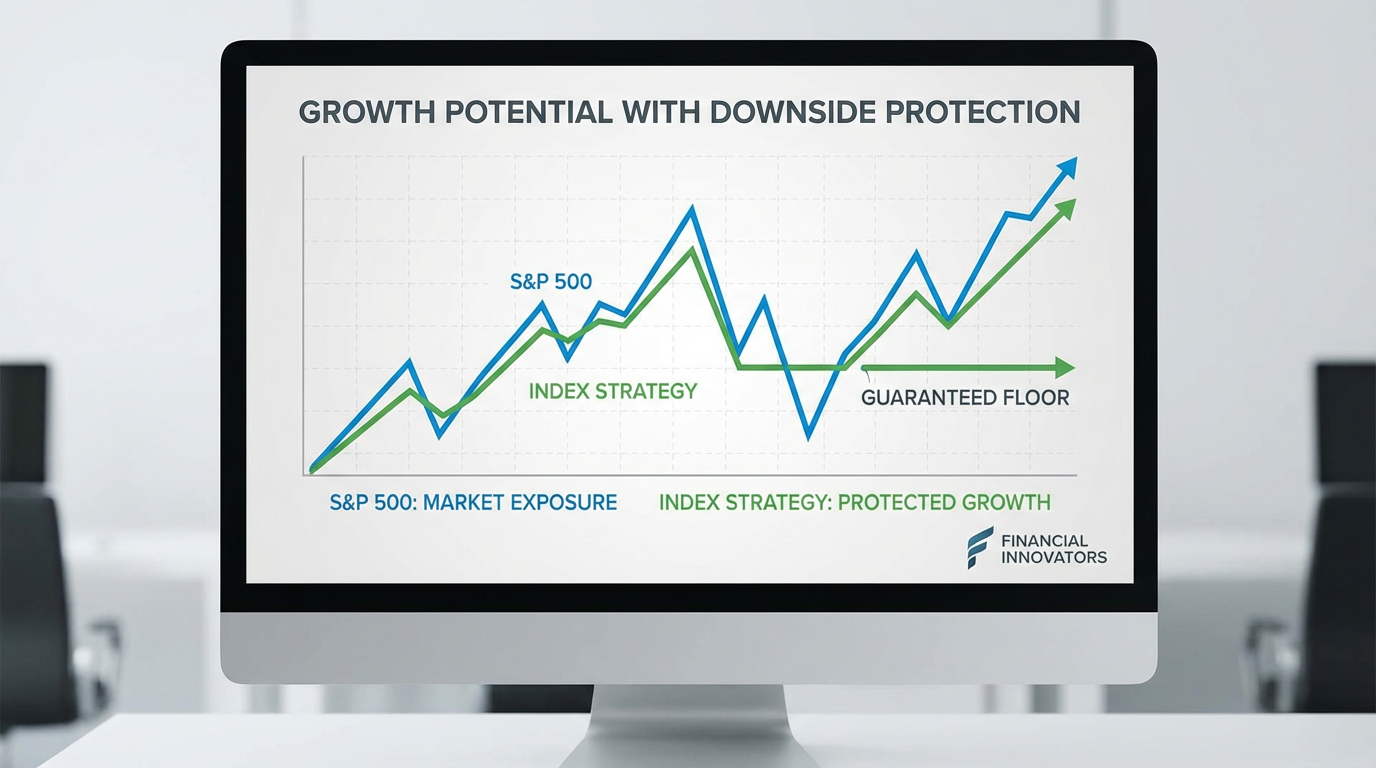
Traditional investment methods often expose investors to the full brunt of market volatility. Many individuals find their retirement savings eroded during economic downturns, an issue compounded by the prolonged recovery times required after significant market losses. In contrast, index strategies offer a balance by limiting downside risk while allowing participation in market gains.
Market volatility is a significant concern for those approaching retirement. With traditional investments, a downturn could significantly deplete savings just when they are needed most. This leads to uncertainty and potentially insufficient income during retirement. Fortunately, there's an alternative approach that can provide stability: index strategies.
Index strategies offer a compelling solution. By securing a guaranteed floor, these strategies protect against losses during downturns, while capturing growth during upswings. At Everence Wealth, we emphasize the importance of ensuring your financial future is protected from market volatility, and indexed strategies are an effective tool in achieving this goal.
What Are Index Strategies?
Index strategies are investment vehicles that track the performance of specific stock market indices, like the S&P 500, without directly investing in the marketplace. This approach provides an opportunity for growth when markets rise, but crucially, it includes a built-in safeguard against losses when the market declines. This is particularly valuable during periods of economic uncertainty or downturn.
The primary appeal of these strategies is participation in index gains up to a predetermined cap. In practice, if the S&P 500 sees a gain of 10%, an index strategy might capture similar gains, subject to specific caps. However, even if markets plummet, the worst-case scenario under an index strategy is a 0% return — offering peace of mind unrivaled by traditional means.
This combination of participation in market growth and protection against decline brings about a reduction in investment volatility, which is crucial for long-term wealth accumulation and preservation.
How Do They Compare to the S&P 500?
The S&P 500 has historically delivered strong long-term returns, often cited as a benchmark for equity market performance. Yet, traditional investments in the S&P 500 carry full exposure to market losses — something index strategies mitigate. With an index strategy, investors do not directly own the stocks but rather earn returns based on the index's performance, with protective measures in place.
Suppose the S&P 500 suffers a 30% loss. With a traditional investment, recovering requires a 43% gain to return to the original level. Index strategies protect against such losses. When the market recovers, the indexed investor benefits from starting at a higher principal balance than an investor who suffered direct losses.
This means index strategies are particularly useful for those close to retirement or already retired, who cannot afford to wait for the markets to recover from substantial losses.
S&P 500 vs Index Strategy: Protected Participation
The S&P 500 has historically delivered strong long-term returns — but with full exposure to market losses. Index Strategies track S&P 500 performance up to a cap rate, while a guaranteed floor ensures you never lose principal when the market drops. You participate in the growth. You are protected from the loss.
If the S&P 500 drops 30%, a traditional investor loses 30% and needs a 43% gain just to break even. An Index Strategy investor loses 0% and captures the next market recovery from their full principal — compounding from a protected base. This is what we call Zero is Your Hero.
The Risk of Volatility in Retirement Planning
Market volatility poses a significant risk to retirement planning. As individuals near retirement, their capacity to recover from financial losses diminishes. The dual threats of a downturn and insufficient savings can devastate a retirement plan that relies heavily on the performance of equity markets.
Indeed, as the market drops, the compounding effect of those losses — and the time required for recovery — can be a significant detriment to financial health. Index strategies mitigate this risk by limiting the down periods to flat performance, effectively providing a safety net against severe market fluctuations.
With the ability to bypass the negative impact of market dips, index strategies are designed to preserve capital during times when others might be losing theirs, ensuring your wealth-building efforts remain steady and secure.
The Benefits of Zero-Floor Investing
The concept of a 'zero-floor' investment is central to index strategies. By guaranteeing that losses will never exceed zero, investors can protect their principal investment, a critical feature for anyone concerned about the potential for loss. This protection means that when markets do turn upwards, the investor’s entire capital base stands ready to capitalize on the ensuing gains.
Index strategies distinguish themselves by offering this low-risk, high-potential approach, freeing investors from fears of negative returns. This is especially pertinent for those whose income in retirement will largely come from their investment portfolio, with no room for capital reduction due to market volatility.
By participating only in the upside of index performance, investors effectively safeguard their retirement security, which, without such measures, could be unduly jeopardized by traditional market exposure.
Implementing Index Strategies in Your Portfolio
Implementing index strategies within your portfolio requires careful planning. At Everence Wealth, we offer detailed assessments to understand how these strategies can complement your existing financial framework. By aligning index strategies with your specific retirement goals, we ensure maximum benefit from the market's upsides while safeguarding against its downsides.
A comprehensive financial needs assessment is integral to tailoring an index strategy to your individual circumstances. This evaluation helps define what role these strategies should play in your broader financial plan, taking into account your risk tolerance, retirement timeline, and financial goals.
Ultimately, index strategies could offer a means to enhance your financial resilience, creating a secure and prosperous future.
About Steven Rosenberg & Everence Wealth
Steven Rosenberg, as the Founder & Chief Wealth Strategist at Everence Wealth, oversees strategies designed to optimize tax efficiency and growth potential across all 50 states. As an independent broker, Steven partners with 75+ carriers, delivering unbiased advice that prioritizes client interests over any individual insurance company or bank. This client-first approach is the cornerstone of Everence Wealth's value proposition — ensuring tailored solutions without compromise.
Secure Your Retirement with an Index Strategy
Interested in discovering how index strategies can enhance your financial security? Schedule a Financial Needs Assessment and let us customize a plan that safeguards your future against volatility and unnecessary tax exposure.
Schedule Your Financial Needs AssessmentThis content is for educational purposes only and does not constitute financial, tax, or legal advice. Consult a licensed professional before making any financial decisions.